Monday, November 12, 2018

From FIANCHETTO: How to name an AI; Introducing Victor Leventon


Below are two short excerpts from my current work in progress, FIANCHETTO. As the manuscript grew very long, I was advised to split it into at least two books. So I have. Book 1, finished, is making it rounds. Book 2 is about 75% finished.

The first excerpt explains the naming conventions for AIs in 2065. The second excerpt is a sample news item from the ubiquitous show "Your/World Live!"

"Your/World" is my name for the all-encompassing world network of data, entertainment, and communications that exists in the novel.

(The ms. formatting has been modified to fit the blog page.)


From the international agreement on the Regulation of Artificial Intelligences, first ratified at the 2040 Your/World Conference in Mexico City (modified 2049, 2054, and 2062):

Article 5: All artificial intelligences classified as Generation 2 and later will be identified by a singular name, in the form of a noun or adjective. This name will be used in all communication by and concerning the device. Each name will be registered with the Your/World Conference, and no two intelligences may have the same name. The device designation may be in any recognized language, including extinct ones (e.g., Latin). Owners and operators of named intelligences are encouraged to use their local language when naming a device. As an orthographic convention, intelligence names must be rendered in ALL CAPITAL letters. This provision does not apply to languages (Chinese, Japanese, Korean, et. al.) in which the Capital/Lower Case convention does not exist. In those languages a special character should be developed to indicate a designation is for an artificial intelligence.

[In Japan, "artificial intelligence" is 人工知能 (Jinkō chinō), and common usage has created the contraction じん の (Jin no). Thus the Tokyo Metro AI known as KAGAMI is formally known as JIN NO KAGAMI in Japan.]

The use of actual proper names is discouraged, as is the use of propagandistic names.

APPROVED STYLE: NAAG (India, "Snake"), XING (China, "Capable"), FROST (U.S. Weather Service), ÁBACO (Brazil, "Abacus"), KAGAMI (Japan, "Mirror"), UPEPO (Tanzania, "Wind"), BULU (Indonesia, "Feather"), MOLNIYA (Russia, "Lightning").

Older device names in styles no longer sanctioned: MEFISTO (Germany, a demon), KILIÇ (Turkey, "Sword"), CESARE (Italy, "Caesar"), BOB (United Kingdom), ESCLAVO (Chile, "Slave"), Θεά (Greece, "Theá," "Goddess"), BETTY (United States).

Disregard of proper nomenclature will result in the withholding of Your/World certification of the artificial intelligence and its operators.

#

Your/World, Thursday. April 1, 2065

It's 12 Noon Greenwich Mean Time, and this is Your/World Live! . . . Votre/Monde en Direct! . . . Nǐ de shìjiè huózhe!. . . Aapki duniya jee rahee hai! . . . Tu Mundo en vivo!

In Your/World today, a new chess prodigy is preparing to challenge for the world chess championship. A 25 year-old electrical engineer, American Victor Leventon, has entered negotiations with Hortalez et Cie and the Russian technical consortium Zhestkiye Nomera to play their respective artificial intelligences for the world chess title.

Artificial Intelligences have held the chess championship for the past thirty years. The last human champion, Anatoly Sherschansky, lost the title after a lengthy match against the early AI MEFISTO in 2035. Since then, the world champion title has passed from AI to AI. The current chess champion, the Swiss AI known as FORT, has held the title since 2063. Rated second in the world is the Zhestkiye Nomera device, ARAKHNA.

Mr. Leventon, who was unknown to the world of chess three years ago, shocked the cybernetic community last year by beating three powerful AIs: China's XING, the Indian university champion NAAG, and most spectacularly, the Turkish government's machine KILIÇ. KILIÇ was built for the Turkish military to analyze defense arrangements and create battle strategy. As part of its training, KILIÇ was instructed in chess, and quickly established itself as a bold and dangerous opponent. It was the first AI to defeat Mr. Leventon, winning the third game of their match. Leventon won the nine game challenge 6-1, with four wins, four draws, and single defeat. To date, no one, human or AI, has managed to defeat Leventon more than once.

Currently, talks are under way to settle the arrangements for the great double match. FIDE, the Fédération Internationale des Échecs, has refused to recognize the games, citing the fact that Leventon is not a member of any affiliated chess organization and has no official chess rating. Some insiders have claimed that if calculated using the standard Elo system, Leventon might have a rating as high as 4000. Current champion FORT is rated at 3633. ARAKHNA is listed at 3490.

Sources in Russia report the match against ARAKHNA may occur as soon as the summer, with a possible championship meeting with FORT by autumn.
#
Referring to my earlier posted sample from FIANCHETTO, Victor is the boy who went wading in the stream and was so excited to see an airplane.  

Wednesday, September 5, 2018

ParaScope, 1996-2002

Related image

Starting the mid-1990s, I was part of a new, web-based publishing effort known as ParaScope. ParaScope was the brainchild of Charles Overbeck (my old compadre from Forbidden Lines). This was the heyday of the original "X Files" TV show, the alien abduction craze, and wacky conspiracy theories were as common as lines of coke in a disco men's room. Into this mix came America Online, the brash new service that aspired to be everyone's access point to the Internet. Those of us above a certain age remember the ubiquitous AOL CD-ROMs that flooded the mail, filled newspaper inserts, and at times seemed to rain down from heaven. 

It was one thing to get people to tune in to the Net via AOL, but AOL wanted to keep users on their site, to better track their interests and expose them to paid advertising. Someone at AOL came up with the "Greenhouse" program, whereby AOL would pay third parties to supply exclusive content. Charles and Ruffin Prevost, another University of North Carolina journalism veteran, pitched ParaScope as an online magazine of weirdness. AOL bought it, and ParaScope was launched. 

The timing was impeccable. 'X Files' was peaking, and interest in UFOs, Fortean phenomena, and government conspiracies was white hot. Before long, an entertainment studio (I think it was New World Pictures?) offered to buy ParaScope. I'm not sure how that would have worked, but it didn't happen. I was editing a portion of the site and not involved in the business end of things.

ParaScope had four basic areas, each with its own editor. "Nebula" was my domain, devoted to UFOs. "Enigma" was where Fortean phenomena was catalogued, along with general weirdness. Donald Trull edited "Enigma." Charles Overbeck oversaw "Matrix," dealing with conspiracies, and "Dossier," which featured actual conspiracy relevant documents, was edited by Jon Elliston.

ParaScope had a good run, but as AOL's fortunes declined, so did ours. "X Files" became tiresome, UFOs were moribund, and endless conspiracy mongering numbed the audience to insensibility. AOL pulled the plug on all the Greenhouse sites. Charles kept ParaScope going for a while as an indie website, but there was no livelihood in it, so it passed into history.

Much of the content from ParaScope is still available on archive.org. Nebula pages can be found at:

http://web.archive.org/web/20020601143200/www.parascope.com/nebula.htm

The following is a sample of my Nebula writing, in this case an historical piece on the origins of the UFO cover-up paradigm. 

The original text has been lightly edited. Modern comments are in red italics.

They Came from New Jersey

Or, How an English Socialist and a 20-Something Wiz Kid Scared the Pants off the Nation and Helped Create the UFO Cover-up Paradigm

by Paul B. Thompson 
[My old ParaScope email address deleted]
One of the most common arguments in the off-center world of UFOlogy is the Cover-up Paradigm. It usually goes like this: the government knows the Truth about UFOs, but is keeping it from the public because the Truth would lead to panic in the streets, the collapse of capitalism and all world religions, and generally be the end of the world as we know it. There are refinements to this theory, of course; that the government's motives are selfish (they want to preserve the Military-Industrial Complex power structure) or altruistic (they want to preserve Human Culture in the face of advanced alien technology), but the basic assumptions have been the same since the late 1940s.

Some of the names and players have changed over the succeeding decades. Once the UFOlogists' bugaboo was the U.S. Air Force and the scientific establishment. Later, under the influence of post-Watergate revelations regarding the foreign and domestic abuses of the intelligence community, UFO researchers blamed the cover-up on the CIA, NSA, and FBI. Some still do, but the current bete noir of UFOdom is an even more shadowy organization (which probably doesn't exist), characterized by fanciful code names like Majestic 12 or the Aviary. [Here I'm being disingenuous. "Probably doesn't exist" should be "definitely does not not exist"!]

In this case, the Who is not so much in question as the Why. Why cover-up UFO reports? There is ample evidence to suggest that those most concerned with researching life beyond our planet are eager for attention -- the recent news conferences about the possibility of Martian microbes [link added, not in original text.] being the best and latest example. Radio signals [link added] and fossilized bacteria are one thing, but extraterrestrial spacecraft are another. Would the government really want to suppress information about ET contact as the Paradigm says? Is there any credible reason to think the panic scenario would actually happen? The usual answer cited took place almost sixty years ago, a remains a classic case of mass hysteria.

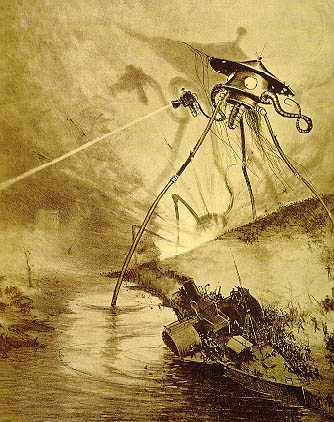
It was just a Halloween spook story, really. In 1938 Orson Welles was the boy genius of American theater. Everything he did caused a stir, both in intellectual and popular circles. His Mercury Theater of the Air [link added] adapted great works of literature to radio format weekly. On October 30, 1938 the scheduled play was Howard Koch's adaptation of H. G. Wells' 1897 novel, The War of the Worlds.

Wells, an idealistic socialist appalled at the cavalier conquest of indigenous peoples by Europeans, wrote his novel as an object lesson on how it felt to be on the receiving end of hostile technology. Koch updated the late Victorian setting by placing the principle action of the story in contemporary America. Instead of the green pastures of suburban England, Koch has his Martian invaders land in rural New Jersey. The Martians emerge in monstrous mechanical fighting machines, kill thousands with Heat Rays and poison gas, and advance on New York with irresistible force. Orson Welles played Professor Pierson, a Princeton astronomer who early on supplies "scientific" commentary to the unfolding story of life on Mars. Gradually Welles/Pierson assumes the narrator's voice (as in Wells' original novel) and describes the ruin of human civilization. The Martians eventually fail, though not by any action mankind takes; native microorganism kill the Martians, and humanity is saved. The radio play follows the basic form of the novel, but utilized the new sensation of immediateness gained from presenting the story in the fashion of news flashes and expert interviews.

That was all very bright and innovative, just the sort of thing Orson Welles was known for. The kicker was, many people listening to The War of the Worlds on the CBS radio network didn't realize they were hearing a fictional story. All across the country people panicked, or fell into passively fatal stupors upon hearing how the Martians were slaughtering their way toward New York. Subsequently studies (see Hadley Cantril's The Invasion from Mars: A Study in the Psychology of Panic,[link added] Princeton University Press, 1940, Harper Torchbooks, 1966) showed that of the six million people who listened to War of the Worlds, about one in six -- one million people -- thought it was a real news broadcast!

Those who believed came from varied economic and educational backgrounds, though it was generally true that more educated people were likely to doubt the authenticity of what they heard. But in the ensuing panic, many people ran wildly into the night, shooting at street lights and water towers. A very small number even attempted suicide rather than face death at the hands of the ruthless Martians. But no generalized rioting occurred, and many of the panic-stricken were brought back to reality when they encountered no further signs of Martian attack.

So far, the War of the Worlds hysteria seems like a good prop to the Cover-up Paradigm, but the story is more complex than most UFO enthusiasts realize. The majority of the panic-stricken on October 30, 1938 were not terrified of Martians, but of Nazis. There had been months of war-scares emanating from Europe (Hitler and [British Prime Minister Neville] Chamberlain had met in Munich to avert war in March), and shortly before the Mercury Theater broadcast President Roosevelt had issued a warning to Hitler to stop making territorial demands on his neighbors. A great many Americans who heard only part of the War of the Worlds broadcast thought the Germans had attacked New Jersey! 

Even when the radio identified the fictional enemy as Martians, people didn't believe it. One man said afterward, "I knew it was some Germans trying to gas all of us. When the announcer kept calling them people from Mars, I just thought he was ignorant and didn't know yet that Hitler had sent them all." Americans in 1938 were fearful of war, but not from outer space. They knew where the real threat came from: the Third Reich.

Ten years later, the United States, Britain, and the Soviet Union had crushed fascism, but a new struggle was developing between democracy and communism. This was the Cold War -- a time of constant strain, of move and countermove, like chess played on a global scale with real nations and real people as pawns. Into this tense situation came the first modern UFO reports, and the U.S. military quickly decided that real or not (and they weren't sure) UFOs needed to be downplayed as much as possible. It would not do to have the civil population living in fear of an alien invasion at a time when Communist invasion or subversion was a genuine threat.

Fifty-eight years after Orson Welles turned H. G. Wells' anti-imperialist fantasy into a modern paradigm, there are many people in this country and others who think the "Martian" scare is still a potent threat to peace and social stability. I for one am not so sure. Despite the prevalence of monster movies and dances of mega-death like the recent "Independence Day," [link added] I have strong doubts that human civilization would collapse after genuine contact with an extraterrestrial race. Given the vast distances and impossibly enormous logistics of interstellar travel, it's hard to imagine a real War of the Worlds. Moreover, we have had seventy years of science fiction in pop culture to insulate our senses to the concept of ET life. When Captain Kirk stood on the bridge of the Enterprise with a friendly alien -- Mr. Spock -- a whole generation learned that beings from another world did not have to arrive in tripod fighting machines wielding death rays and poison gas. The positive, even religious aspects of alien contact are a strong undercurrent in both science fiction and UFO lore. They may come to wipe us out, or they may come in peace and teach us how to end war, disease, and suffering. [In the 1950s, this was the common message of the 'contactees,' those cultists who claim to have met benevolent, human-like aliens.]

In the end, the truer paradigm of UFOs in western culture may not be Wells' War of the Worlds, but the Cargo Cults [link added] of the Pacific Islanders. The people of Micronesia lived simple lives before 1941, aware of Asian and European traders and explorers, but indifferent to them. Then, during America's war with Japan, thousands of sailors, marines, and soldiers descended on the sleepy archipelagos with concrete, bulldozers, airplanes, and beer. Here was the dazzling "cargo" the islanders had never dreamed off, and they turned their delight into a folk religion. For decades after the war they built "airfields" lined with bamboo and palm frond "airplanes" in hopes of luring back the wonderful foreigners and their cargo.

Perhaps that's what UFOlogy really is -- a cargo cult for the First World. We don't build bamboo saucers to lure them to us, but beam "Star Trek" into space daily. One day they may notice us and save us from ourselves.


(c) Copyright 1996 ParaScope, Inc.

Monday, August 27, 2018

My Bookly Summer

"Hmm, Guderian was right not to want 
any offensives in Russia in 1943."


I've taken the past couple of months off from this blog, just for the summer. My kids have been out of school, we traveled a bit, and I've been working like crazy on my new novel, so the blog has been neglected. This week the young Thompsons go back to school, and for all practical purposes summer will end. Before resuming the roll-call of my past novels, I thought I'd take a moment to describe my summer reading.

"Summer reading" is a thing, of course. Bookstores promote the concept, even marketing titles as "perfect summer fare," "just right for the beach," etc. I read the year round, constantly, but I happened to have scored a rich harvest of interesting books this summer. Because of the confluence of several anniversaries--my birthday, my wedding anniversary, Fathers' Day--I often reap the benefits in June. This year I've continued to find good stuff serendipitously, in thrift stores and library book sales, for example.

About the title; having a book-filled summer just cried out for a new descriptive term. "Bookish" doesn't fit. I am always bookish, and it implies behavior rather than a condition. "Bookly" popped into my head as a facetious new adverb to describe the state of having acquired many new books. A library sale is a bookly event. So's a birthday, in my case. 

June 2018:


How Did It Begin? by Dr. R & L. Brasch. Hardcover. New York: MJF Books, 2014. 328 pp. ISBN 978-1-60671-271-9

My children gave me this book for my birthday. We were in Quebec City that day, and after devouring the last cake available from the patisserie around the corner, I unwrapped this. This highly readable book describes the origins of many common items, beliefs, and practices. Why do lapels have notches or slits? Why do we say "raining cats and dogs?" Who was the real McCoy? The authors (a United Nations Peace Prize winner, rabbi, and former researcher for Encyclopedia Britannica) supply answers, presumed answers, and folk wisdom to answer these and scores of other points of origin. 

Good stuff. A perfect bathroom book, as it consists of short essays rather than lengthy chapters on each topic.


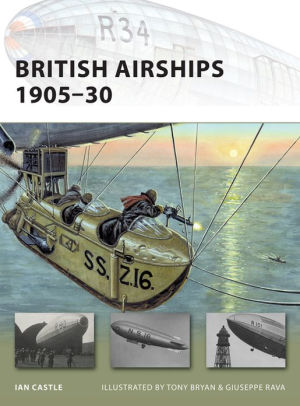
British Airships 1905-30


British Airships 1905-30, by Ian Castle. Trade paper. Oxford, UK: Osprey Publishing, 2009. 48 pp. ISBN 978-1-84603-387-2

Another birthday gift, this time from my wife. I love Osprey Books. They're lavishly illustrated, well-written, erudite booklets on all aspects of military and technological history--airplanes, tanks, uniforms, battles, campaigns, and yes, airships, from all eras of history from ancient times to yesterday. 

Regarding airship technology, the British played catch-up for this entire period, trying to match or exceed German progress with Zeppelins. During World War I they extemporized a whole series of small coastal blimps for anti-submarine duties by suspending airplane fuselages under cigar shaped envelopes. These A/S blimps did yeoman service. The British had less success with their rigid (Zeppelin type) airships. Though some, like R-80 and R-100, designed by Sir Barnes Wallis, were successful, most performed poorly and a couple crashed with heavy loss of life. Oddly enough, a forgotten British airship, R-34, completed the first non-stop crossing of the Atlantic, in both directions, in 1919. That's eight years before Lindbergh flew one way, non-stop.

Barnes Wallis, by the way, has long been one of my heroes. A great man.

Another excellent Osprey title. Not as detailed as the studies of Douglas Robinson, but a great introduction to the subject, and it's replete with many photos and illustrations.

While we're on the subject of airships:


The Zeppelin in Combat, by Douglas H. Robinson. Hardcover, Atglen, PA: Schiffer Publishing Ltd., 1994. 410 pp. ISBN 0-88740-510-X

My anniversary present. Let me be clear: this is a magnificent book! The original edition of Robinson's study of World War I German airships was published in 1962. This 1994 edition is a large format coffee table book, mating Robinson's authoritative text to a large collection of original photographs. The author covers every theater where Zeppelins were employed, Imperial Army and Navy ships, early civilian Zeppelins, Schutte-Lanz airships, their construction and the men who flew them. Allied countermeasures are covered as well. The technology of rigid dirigibles is frankly amazing. Did you know Schutte-Lanz airships' frames were made of plywood? Or that a 1916 Zeppelin could fly 1,500 miles, carrying (typically) 4,000 pounds of bombs, plus a full crew? Of course their top speed was around 50-60 MPH, but airplanes in those days could barely manage 80-90 MPH, and their bomb loads were often less than 100 pounds. 

If you read only one book on this subject, let it be this one. 


My last birthday present tied-in with our vacation to Canada:


Quebec, 1759 The Siege and the Battle, by C. P. Stacey. Trade paper, Montmagny, Quebec: Robin Brass Studio, 2006. 294 pp. ISBN 978-1-896941-738.

This book is widely considered the best account of the British capture of Quebec City in 1759. Author Charles Perry Stacey was not only a Princeton graduate and scholar, he was also a serving officer in the Canadian Army. This monograph, first published in 1959, refutes many of the romantic notions about the Quebec campaign. I learned a lot reading this book; for example, though General James Wolfe is regarded by the British as an eccentric military genius who died at the threshold of victory, much of the real credit for the conquest of Quebec goes to Admiral Charles Saunders, who navigated several heavy warships up the St. Lawrence River to close the waterway and land British troops and artillery below the city. This coup caught the French completely by surprise. From that point Quebec was doomed. Wolfe made several tactical mistakes in the ensuing campaign, but his army's nighttime climb to the Plains of Abraham brought about his famous victory. 

Stacey writes well, serious enough for academic study, but with the acuteness of a military man. I highly recommend this book.

July 2018:


Hitler's Elite: The SS 1939-45

Though I bought these books separately, they're obviously a set, so I'll discuss them together.

Hitler's Armies, edited by Chris McNab. Oxford, UK: Osprey Books, 2015. 424 pp. ISBN 978-1-4728-1533-0.

Hitler's Elite, edited by Chris McNab. Oxford, UK: Osprey Books, 2015, 384 pp. ISBN 978-1-4728-1552-1. 

Osprey strikes again! These books are compilations put together from individual Osprey booklets. Very high quality productions, heavyweight glossy paper, original paintings by Osprey artists detailing uniforms, weapons, etc. 

Hitler's Armies is a history of the German Army, obviously. There doesn't seem to be comparable volumes on the Luftwaffe or Kriegsmarine yet (take the hint, Osprey!) Because of the publisher's focus on military details, the book is detail oriented; the reader gets insight on topics like the parachutes used by the Fallschirmjager. (Why did they jump head first out of airplanes?) The origin and development of camouflage battledress (first made for the Waffen SS), details of equipment and other minutia. If this sounds too specialized for the average reader, it's not. The book is so well illustrated and accessible it never feels bogged down in too much detail. Wargamers and re-enactors will love these books. I don't follow either hobby, I just delight in rich details and abundant information. 

Hitler's Elite is an illustrated history of the Waffen SS, the armed contingent of Hitler's elite guard, the Schutzstaffeln ("Protection Squads"). The origins and crimes of the SS have been well documented, but there exists a body of literature in German and English (maybe other languages too) advocating the thesis that the Waffen SS were not criminal participants in the Holocaust and other atrocities committed on every front where German forces were engaged but North Africa. Waffen SS apologists like to claim they were "soldiers like any others," and that their formations were progenitors of the Pan-European armies of NATO. This is nonsense of course. Aside from actual battlefield war crimes (Oradour, Malmedy, Le Paradis, et. al.) it is plain from German records that there was a steady circulation of personnel and officers in and out of the battle formations into mass-murder squads and the concentration camp system. 

Hitler's Elite is not one these apologetic books. The book's focus is on the usual Osprey interests--uniforms, insignia, weapons. While the historical outline is quite good, this book would mainly appeal to the collectors of militaria, wargamers, and re-enactors.

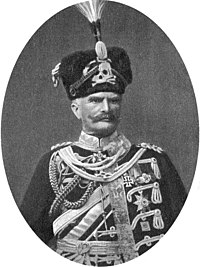
A modest but interesting detail I learned from these books: The SS's skull insignia became infamous both due to their ferocity in combat and for their crimes against humanity. The German Army also used a totenkopf (death's head) insignia as the symbol of their Panzer (tank) corps. The death's head has historical significance for the German military far predating the Nazi era. Various light cavalry regiments used a skull and cross bones emblem (on black uniforms, no less) back to Napoleon's era and earlier. For comparison:


Image result for ss totenkopf
The SS death's head. Notice the skull has the jaw attached.


Image result for panzer totenkopf
German Army panzer insignia (front and back): more bones, jawless skull.


Field Marshal von Mackensen, circa 1914, with a really big death's head on his busby.


British death's head: insignia of the 17th Lancers.


The flag of English pirate Edward England, circa 1718.

Barnes & Noble has these books for $12.98 each, a steal. 


August 2018:


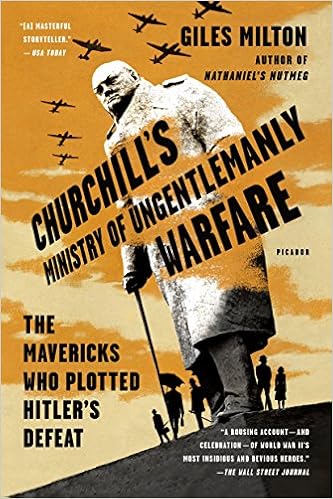
Churchill's Ministry of Ungentlemanly Warfareby Giles Milton. Hardcover, New York: Picador Books, 2017. 356 pp. ISBN 978-1-250-11902-5. (First published in the UK in 2016.)

Giles Milton has written a number of popular books about the byways of history, the strange backwaters that precede or follow great events. He's very good at finding the personalities behind the public images of heroes and villains. In Churchill's Ministry, he chronicles the origins and growth of Britain's campaign of sabotage, assassination, and every sort of clandestine mayhem against Nazi Germany. I am familiar with large portions of this story, having grown up reading books like Gerald Pawle's Secret Weapons of World War II and Janusz Piekalkiwicz's Secret Agents, Spies, and SaboteursWhat Gilman offers beyond these previous accounts are detailed glimpses at the eccentric military men, and even more eccentric inventors who constantly dreamed up new ways to torment the Nazi occupiers of Europe. In a weird way, you almost (almost) feel sorry for the Germans having to deal with the fiendish and bizarre devices the British dreamed up to defeat them. Tanks and planes and warships are known facets of warfare, but hold on to your credulity as you read Gilman's description of sticky bombs, magnetic limpets, sideways shooting mortars, mines of every description, poisons, silenced pistols that fit in a rolled-up newspaper, silent time pencils for detonating infernal machines . . . let us all be glad these fellows were on our side. 

It's worth remembering that when German Army officers plotted to kill Hitler, the closest they came was on July 20, 1944, when a briefcase loaded with explosive detonated in Hitler's forest headquarters. He escaped death by sheer chance, but the bomb did explode--thanks to a British silent detonator captured by the Germans!

This book is decorated with such characters as "the Deacon," a hand to hand fighting expert who resembled a benign clergyman, or the lecturer who started classes in sabotage by setting the timer on a bomb on his lectern and announcing, "This will go off in five minutes." It was a real bomb, too. The same man's profession in civilian life? He designed and built camper trailers, what the British call caravans.

Forget James Bond or Mission: Impossible. These guys were the real deal.

I got this book, in brand new condition, from a local PTA Thrift shop for $1.00.


Requiem for Battleship Yamato, by Yoshida Mitsuru. Hardcover. London: Constable and Co., 1999. First published in English, 1985. 152 pp. ISBN 0-09-479780-3.

This book was a totally random find. The local branch of the Durham County Library system keeps a shelf of donated books for sale to patrons. I found this mint copy, paying $3.00 for it.

Yoshida Mitsuru was a young naval officer, only 22 years old when he served aboard Japan's last, biggest battleship, the IJN Yamato, in 1945.

(I am still reading this book and will update on it later. First impression: a very romantic, lost-cause memoir of a youthful naval officer.)

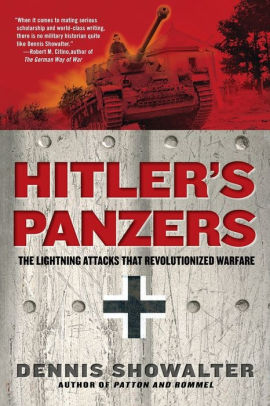
Hitler's Panzers: The Lightning Attacks That Revolutionized Warfare

Hitler's Panzers, by Dennis Showalter. Hardcover. New York: Berkley Caliber, 2009. 390 pp. ISBN 978-0-425-23004-6. 

My last summer aquisition I found in a small used book shop in Pittsboro, N.C. for all of $6.00.

Dennis Showalter is a military historian specializing in the period from Napoleon to the end of World War II. His particular area of expertise is Germany.

Hitler's Panzers describes the development of the German Army's tank forces, from the days of Weimar's plywood simulated vehicles to the iconic Tigers and Panthers at the war's end. Tank warfare evolved between the wars in many countries, with the purest form of all-tank campaigning being promulgated in the Soviet Union. In Germany, tanks were seen not only a force multiplier, but a weapons system by which outnumbered German divisions could redress the balance of power in their favor. The result of these experiments, trials, and theorization was the panzer division of World War II, an all-arms organization capable of striking, paralyzing, and crushing enemy formations. 

Image result for German cardboard tanks
Germany, 1928: Simulated tanks on bicycle frames

Yet it was not always as the legends say. French tanks in 1940 were better, machine to machine, than their opposite German numbers. The French employed their tanks in antiquated fashion, as rolling pillboxes supporting the advancing infantry. The Germans instead employed coherent armored spearheads, to breakthrough enemy lines, enter vulnerable rear areas, and destroy the enemy army's nervous system of communications, supply, and support. Later, faced by Soviet tanks superior in armament, armor, and numbers, panzer divisions were forced into defensive tactics completely different from the blitzkrieg days of 1939-41.

By the way, the Germans did not coin the term "blitzkrieg" (lightning war). TIME magazine did . . . and Hitler purportedly didn't like the term. 

Showalter does discuss the characteristics of various German tanks, but this is not like an Osprey book detailing gun calibers and armor thickness, etc.

Ironically, in the last 18 months of the war, the panzers found themselves in much the same role as French tanks in 1940: powerful, mobile forts whose main job was to protect outnumbered German infantry from swarms of Soviet, American, and British tanks. Individually, Panthers and Tigers were usually superior to T-34s, Shermans, or Churchills, but their small numbers and lessened mobility (due to heavier and heavier armor), doomed them in the kind of fluid, fast-moving mobile warfare their predecessors pioneered.

Solidly written, a very satisfying read. 

Later: Back to Krynn.

Friday, May 11, 2018

The Sundipper Soundtrack

What do Jacques Offenbach and Cass Elliott have in common?


Their work is referenced in my current work in progress, "Fianchetto;" specifically, the duet "Belle nuit, ô nuit d'amour" and Elliott's 1968 recording of "Dream a Little Dream of Me." The Offenbach piece is from the opera Tales of Hoffmann and is better known as the "Barcarole." It serves as the signature of a relationship between two of the characters, as does "Dream a Little Dream."

I've always had a strong attachment to using music in the stories I write. This was particularly true in my 1987 novel Sundipper. I think this reflects the essentially cinematic approach I often use when writing. I see scenes unfold like a film, with movement, dialog, and of course, music. For this blog entry I'd like to present the Sundipper 'soundtrack.'

In an early chapter, the protagonist, Matthew Lawton, launches his spacecraft into the Sun's chromosphere while listening to the first movement of Beethoven's Third Symphony, Eroica:


You! Yeah, you!

Later in his lonely mountaintop retreat in the Black Mountains of North Carolina, he consoles himself with the exquisite, desperately poignant First Violin Concerto by Sergei Prokofiev.


The man himself.
It's marvelous.

Lawton encounters the equally lonely widow of a powerful politician who has a secret of her own. Oh, and she's fascinated by the Music of Tin Pan Alley, and crooners from Perry Como to Dean Martin. She also collects LPs, and this was written in 1986, long before the current hipster revival of interest in vinyl. This is why I paid to quote song lyrics of the famous standard, "Till the End of Time," itself adapted from Chopin's Polonaise in A flat major, Op. 53, the "Polonaise héroique".

Perry Como's version may be the most famous, but I like Sarah Vaughan's. The version I remember best, by the Ray Charles Singers, was played a lot on the radio when I was kid:


This is not by the Ray Charles who
gave us "I Got a Woman," but the stage
name of composer/arranger

or better yet,

Sasha, the widow, believes this kind of music is one of the pillars of human civilization. No, really. She has reasons for thinking so, and they're not merely tongue in cheek. 


"Shades," by Dean Martin

Lawton tries to wean her off mid century crooners and back to the classics, mentioning Prokofiev's Sixth Symphony as one of his choices. The Sixth is widely considered Prokofiev's elegy to the dead of World War II:

"Now we are rejoicing in our great victory, but each of us has wounds that cannot be healed. One has lost those dear to him, another has lost his health. These must not be forgotten."

In a far lesser way, this can be considered the end of the Sundipper soundtrack, as Prokofiev's words also apply to Matthew Lawton's fictional life.


"The light they carried went with them."


FIANCHETTO: The Rogues' Gallery

For my own amusement, I recently used Google's Gemini AI to create images based on characters and incidents in Book 1 of my novel FIANCH...