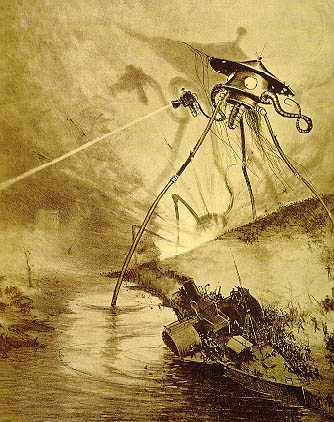
(Cover wrap for Nemesis; art by Mark Zug.
Belbe and Ertai, left; Crovax, right.)
Belbe and Ertai, left; Crovax, right.)
In 1998 I was invited out to Renton, Washington, to participate in story conference at Wizards of the Coast (WOTC). I'd been asked to join a group of four writers, who, along with various editors and WOTC staffers were tasked with reviving and redefining the entire scope of Magic: the Gathering (MtG) themed novels. The four writers were Jeff Grubb, J. Robert King, Loren L. Coleman, and myself.
WOTC had acquired the failing TSR in 1997, reportedly for $25 million. Many of the past and present TSR editors ended up in Renton, keeping alive not only the Dragonlance line of novels, but midwifing the rebirth of MtG novels.
The first thing we were told was that all previous Magic novels published between 1994-96 were null and void. "Forget they ever existed." A new, complex story line was evolved about an interplanar war between the an Earth-like fantasy world called Dominaria and a polluted, techno-fetishist nightmare world called Phyrexia. The Phyrexians have created an artificial planet, Rath, and plan to "overlay" Rath onto Dominaria as a form of colonization and conquest.
| Cycle | Year | Title | Author | Pages | ISBN |
|---|---|---|---|---|---|
| Artifacts | 1998 | The Brothers' War | Jeff Grubb | 409 | ISBN 0-7869-1170-0 |
| 1998 | Planeswalker | Lynn Abbey | 359 | ISBN 0-7869-1182-4 | |
| 1999 | Time Streams | J. Robert King | 343 | ISBN 0-7869-1344-4 | |
| 1999 | Bloodlines: The Story of Urza's Destiny | Loren L. Coleman | 343 | ISBN 0-7869-1380-0 | |
| 1999 | The Thran | J. Robert King | 311 | ISBN 0-7869-1600-1 | |
| Ice Age | 1999 | The Gathering Dark | Jeff Grubb | 342 | ISBN 0-7869-1357-6 |
| 2000 | The Eternal Ice | Jeff Grubb | 320 | ISBN 0-7869-1562-5 | |
| 2000 | The Shattered Alliance | Jeff Grubb | 309 | ISBN 0-7869-1403-3 | |
| Masquerade | 1999 | Mercadian Masques | Francis Lebaron | 341 | ISBN 0-7869-1188-3 |
| 2000 | Nemesis | Paul B. Thompson | 320 | ISBN 0-7869-1559-5 | |
| 2000 | Prophecy | Vance Moore | 311 | ISBN 0-7869-1570-6 | |
| 1998 | Rath and Storm | Peter Archer, editor | 311 | ISBN 0-7869-1175-1 |
After establishing basic plot points and wish lists for story accomplishments, the writers divvied up the assignments. (Vance Moore, Lynn Abbey, and Francis Lebaron were not present at the conference). Hearing that the middle book of the "Masquerade" sequence would be set on the dark, violent world of Rath, I lobbied for this assignment. I remember being told, "This one will have to be dark and gritty." To which I replied, "I can do dark and gritty."
There was some debate about the title. The first, facetious suggestion was to call it "The Book of Rath," a bit of word play on the Catholic poem Dies Irae:
Dies irae (Latin pronunciation: [ˈdi.ɛs ˈi.rɛ]; "Day of Wrath") is a Medieval Latin poem. The poem describes the Last Judgment, trumpet summoning souls before the throne of God, where the saved will be delivered and the unsaved cast into eternal flames. It is best known from its use in the Requiem (Mass for the Dead or Funeral Mass). [after Wikipedia].
"Book of Rath" was not a serious choice (though it worked for me), so the working title became "Dark Fortress." Later, when the novel was in manuscript but not yet published, the title was finalized as Nemesis, which I was told would tie it in more closely with some Magic card sets under development.
I was supplied with a vast amount of material on the Dominaria/Rath multiverse. On my way home from Renton I conceived of a new character, the catalyst for much of the action in the story: Belbe. Belbe is a cyborg, part living, part artificial. In life she was a young elf woman, daughter of the rebel chieftain Eladamri. As part of a complicated plot, the sinister Phyrexians kill her but carry off her body to create their emissary to Rath, Belbe. Though created by soulless, Lovecraftian techno-monsters, Belbe is a clean slate, a tabula rasa in the mental and ethical sense. Though her stated purpose is to choose a new ruler for Rath, she is in fact the focus of a cruel, clever experiment in free will. The Phyrexian villains have reduced themselves to mechanistic functions. They remember free will and morality as remote concepts, but they have done without them so long they no longer grasp how living, free beings think, or why they resist subjugation. They embed a remote viewing device in Belbe's body and send her to Rath to observe the struggle for power--and to study her own struggle for understanding Right and Wrong, self vs. her place as a cog in Phyrexia's juggernaut of conquest. That's what Nemesis is really about.
It's a dark story. WOTC made me tone it down, too. It was much darker and kinkier in draft than the finished novel. Though WOTC had a more mature attitude toward its audience than TSR did, they did make me soften the violence and remove most of the sexual aspects. I was fine with that; the novel stands well on its own as published.
Nemesis did well, and has a fan base to this day. Oddly, though I wrote a handful of MtG short stories afterward, I was not asked to write any more MtG novels. I suspect this had more to do with branding than any editorial dissatisfaction with my work. WOTC had taken on several of TSR's editorial staff, and to them I was a Dragonlance author first and foremost. Too bad! I enjoyed writing Nemesis, and I would have liked to follow it up, but alas! It was not to be.
Concerning a plot point: prior to their close encounter, Belbe asks Ertai if he can blind the lens embedded in her body (so they can have a little privacy!). He tries, but he doesn't know if his magical charge actually blinds the lens or not.
It doesn't.
A lot of reviewers/readers assume it did. Belbe and Ertai carry on as if it did, but Ertai's attempt to block the link back to Phyrexia is too puny to be effective. So Abcal-dro and company saw everything. Not that it matters to the lovers, but Belbe never escapes her overlord's surveillance. Even after her death and cremation, the lens is still sending sound and images back to Phyrexia . . .
Concerning a plot point: prior to their close encounter, Belbe asks Ertai if he can blind the lens embedded in her body (so they can have a little privacy!). He tries, but he doesn't know if his magical charge actually blinds the lens or not.
It doesn't.
A lot of reviewers/readers assume it did. Belbe and Ertai carry on as if it did, but Ertai's attempt to block the link back to Phyrexia is too puny to be effective. So Abcal-dro and company saw everything. Not that it matters to the lovers, but Belbe never escapes her overlord's surveillance. Even after her death and cremation, the lens is still sending sound and images back to Phyrexia . . .
Bit of trivia: I created a secondary character for Nemesis called Liin Sivi, whose weapon of choice is a whip tipped with a double-ended knife. Along the way the MtG card designers changed the spelling of her name to "Lin Sivvi," but she's my creation, so the change/mistake is theirs. I suppose they were daunted by the double-i spelling, though her name would be pronounced 'Leen See-vee,' as opposed to the card designer's 'Lin Sivvy.' Not a large deal, but a lot of readers comment on the alleged mistake, assuming the card takes precedence over the novel--which it does not, as far as I'm concerned.
Mark Zug did a fine cover for the book, though I wish WOTC had put Belbe and Ertai on the cover and Crovax on the back.
The book is dedicated to my good friend Jennifer Lee.
Mark Zug did a fine cover for the book, though I wish WOTC had put Belbe and Ertai on the cover and Crovax on the back.
The book is dedicated to my good friend Jennifer Lee.
Through a Darkling Glass
The following is a portion of an essay about the MtG "Masquerade" series. Specifically, this part is a detail description and analysis of Nemesis. Excerpted from "Remember the Weatherlight, Part 4," by Shannon Rezendes. All rights reserved to the original author.
Lightly edited by me, chiefly removing links not necessary for a non-MtG playing reader.
Nemesis
was
probably the best of the books since The
Brothers’ War
and
remains a favorite, both for depth of characterizations and for the
decidedly dark tone (I have left some details out of my summary, so
you should track the book down to get the full story). Though sullied
by some questionable continuity (like [Mercadian] Masques
but
to a lesser extent), the quality of the story made it worthwhile. The
story picks up moments after Weatherlight
blazed
its way out of Rath, at the end of Exodus.
Eladamri’s daughter is assassinated
in
her sleep – but not simply to make the elf warlord suffer. Her body
is taken to Phyrexia itself, and…modified.
The new creation, Belbe,
has a specific task – return to the Rathi Stronghold, and oversee
the power struggle about to ensue. Volrath has abandoned his post to
pursue Gerrard, leaving a
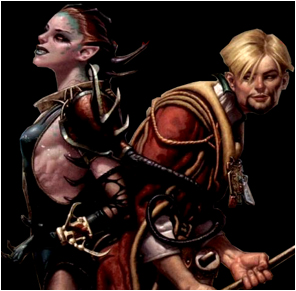
This
unlikely pair suffered the worst hosing
of any two
characters in the Saga.
power
vacuum at a critical time. The artificial
plane
is
nearing completion, and as it does so, begins to overlay
with
Dominaria more frequently. The day of the final overlay fast
approaches, when all the Phyrexian forces are instantly transposed
onto the surface of Dominaria. Those forces need a leader. Belbe is
to make sure one is found.
The Phyrexians already seem to have a candidate in mind, however – or a faction of them do at any rate. Crovax, cursed, hateful, awakens somewhere in Phyrexia. The Dark Lord, it seems, has had interest in him for some time. They show him his true vampiric nature, show him how to consume the life force directly from the living, and make him an offer – submit to Yawgmoth, and rule. One taste of someone else’s life is all he needs to make his decision. Like Volrath before him, he is heavily modified, but not in the same style; instead of Volrath’s subtle shapeshifting, Crovax is given raw strength and power, and most dangerously of all, is relieved of his mortal conscience. Freed from guilt and duty, he is crafted into a true Phyrexian – an unstoppable, unkillable predator.
He will not be simply given the office of Evincar, however. That is not the Phyrexian way. He shall have to earn it through struggle, by overcoming and conquering other claimants to the throne. His unlikely opponents are not given such Phyrexian support as he is, making his victory seem a foregone conclusion, but the Phyrexians still wish to see him earn his post, and be strengthened by the battle for it.
On Rath itself, the wounded Predator limps back to base, Greven heroically – yet viciously – rallying his crew to keep the skyship in the air. Needless to say, he is not in a good mood when he discovers a stowaway from Weatherlight: Ertai. The fate of the cocky young wizard was something fans of the story had been desperate to know of for a year and a half at this point – he was a popular character who was quite thoroughly screwed over by the rest of the heroes. Magically repelling the Predator crew’s attempts to kill him, Ertai is spared by Greven, who decides at the very least he is worth interrogating – and not wishing to return to Volrath empty handed. Moreover, Greven respected the wizard’s talents at holding back his crew. He privately suggests to Ertai to submit, as he did, to Volrath’s lordship – servitude is better than death. Ertai senses Greven’s spinal implants, and realizes that Greven, in his own way, is as much a prisoner as he.
Predator arrives finally at the Stronghold, but is unable to dock. Greven finally brings Ertai to the bridge to magic them into port – after all, if they crash, he dies too. Greven does what he can to help, but even with Ertai’s considerable ability, it’s something of a controlled crash. Ertai then considers ramming Predator into the Stronghold itself, destroying the ship and devastating the citadel, but decides that his own potential is far too great to waste in a suicide attack. Even so, the ship barely survives the spell Ertai has to use to slow it down, and he is fully spent afterward.
Greven finds the Stronghold in chaos. Though Eladamri’s attack had been repulsed after breaching the outer defenses, Weatherlight had escaped, and Volrath was nowhere to be found. Greven realizes that his despised master had been on Gerrard’s ship, and that, for the moment at least, he was free. The terrified Rathi thralls beg for him to take over, but he declines – he decides instead to notify the dark powers behind Rath, to pick the next Evincar as they always had. Greven does this partly from fear of reprisal, should the Phyrexians not approve of his ascent, but just as much from lack of further ambition – he is a warrior, not a governor (despite how much he may look like Arnold Schwarzenegger). When the Phyrexians say they will be sending an emissary to select the next Evincar, Greven asks if it would not be more efficient to simply appoint someone – and is punished for such insolence. Along with Belbe, the Phyrexians deposit Crovax (or what has become of him) in the Dream Halls, thirsting for blood and with the flowstone that composes the world at his command. But he is not the only one – Ertai, experimenting in spare moments, improvises a modicum of control over the substance.
Crovax reveals himself to the Rathis – and Ertai – first, claiming already to be the Evincar. Greven attacks the newcomer as a pretender, but is unable to kill Crovax before the fighting is interrupted by Belbe’s arrival. Crovax introduces himself as the new Evincar, and is rebuked – while he knew not of Belbe, she has been informed of him. Greven introduces himself and asks for orders, while Ertai, out of turn, introduces himself, and begins to flirt, though he is quickly taken away to be interrogated. Crovax sets immediately to work cowing the courtiers and gaining allies, including another of Greven’s ambitious subordinates (remember Vhati?).
As for Belbe herself… though we never met Eladamri’s daughter in life, there is a distinct sprightliness left in the Phyrexianized elf’s personality. When not in public, she is contemplative, or playful, or lonely. She takes up residence in Volrath’s rooms – finding a telling statue of the Evincar, without a face. When considering who she has met thusfar, only Crovax and Ertai have interested her: the former, because of his obvious Phyrexian favor and dangerous personality; the later, because of his quick wit and overwhelming self confidence. And I mean overwhelming. A few levels down, at that very moment, Greven is trying to torture information from the wizard, but Ertai does everything in his power to resist.
The Phyrexians already seem to have a candidate in mind, however – or a faction of them do at any rate. Crovax, cursed, hateful, awakens somewhere in Phyrexia. The Dark Lord, it seems, has had interest in him for some time. They show him his true vampiric nature, show him how to consume the life force directly from the living, and make him an offer – submit to Yawgmoth, and rule. One taste of someone else’s life is all he needs to make his decision. Like Volrath before him, he is heavily modified, but not in the same style; instead of Volrath’s subtle shapeshifting, Crovax is given raw strength and power, and most dangerously of all, is relieved of his mortal conscience. Freed from guilt and duty, he is crafted into a true Phyrexian – an unstoppable, unkillable predator.
He will not be simply given the office of Evincar, however. That is not the Phyrexian way. He shall have to earn it through struggle, by overcoming and conquering other claimants to the throne. His unlikely opponents are not given such Phyrexian support as he is, making his victory seem a foregone conclusion, but the Phyrexians still wish to see him earn his post, and be strengthened by the battle for it.
On Rath itself, the wounded Predator limps back to base, Greven heroically – yet viciously – rallying his crew to keep the skyship in the air. Needless to say, he is not in a good mood when he discovers a stowaway from Weatherlight: Ertai. The fate of the cocky young wizard was something fans of the story had been desperate to know of for a year and a half at this point – he was a popular character who was quite thoroughly screwed over by the rest of the heroes. Magically repelling the Predator crew’s attempts to kill him, Ertai is spared by Greven, who decides at the very least he is worth interrogating – and not wishing to return to Volrath empty handed. Moreover, Greven respected the wizard’s talents at holding back his crew. He privately suggests to Ertai to submit, as he did, to Volrath’s lordship – servitude is better than death. Ertai senses Greven’s spinal implants, and realizes that Greven, in his own way, is as much a prisoner as he.
Predator arrives finally at the Stronghold, but is unable to dock. Greven finally brings Ertai to the bridge to magic them into port – after all, if they crash, he dies too. Greven does what he can to help, but even with Ertai’s considerable ability, it’s something of a controlled crash. Ertai then considers ramming Predator into the Stronghold itself, destroying the ship and devastating the citadel, but decides that his own potential is far too great to waste in a suicide attack. Even so, the ship barely survives the spell Ertai has to use to slow it down, and he is fully spent afterward.
Greven finds the Stronghold in chaos. Though Eladamri’s attack had been repulsed after breaching the outer defenses, Weatherlight had escaped, and Volrath was nowhere to be found. Greven realizes that his despised master had been on Gerrard’s ship, and that, for the moment at least, he was free. The terrified Rathi thralls beg for him to take over, but he declines – he decides instead to notify the dark powers behind Rath, to pick the next Evincar as they always had. Greven does this partly from fear of reprisal, should the Phyrexians not approve of his ascent, but just as much from lack of further ambition – he is a warrior, not a governor (despite how much he may look like Arnold Schwarzenegger). When the Phyrexians say they will be sending an emissary to select the next Evincar, Greven asks if it would not be more efficient to simply appoint someone – and is punished for such insolence. Along with Belbe, the Phyrexians deposit Crovax (or what has become of him) in the Dream Halls, thirsting for blood and with the flowstone that composes the world at his command. But he is not the only one – Ertai, experimenting in spare moments, improvises a modicum of control over the substance.
Crovax reveals himself to the Rathis – and Ertai – first, claiming already to be the Evincar. Greven attacks the newcomer as a pretender, but is unable to kill Crovax before the fighting is interrupted by Belbe’s arrival. Crovax introduces himself as the new Evincar, and is rebuked – while he knew not of Belbe, she has been informed of him. Greven introduces himself and asks for orders, while Ertai, out of turn, introduces himself, and begins to flirt, though he is quickly taken away to be interrogated. Crovax sets immediately to work cowing the courtiers and gaining allies, including another of Greven’s ambitious subordinates (remember Vhati?).
As for Belbe herself… though we never met Eladamri’s daughter in life, there is a distinct sprightliness left in the Phyrexianized elf’s personality. When not in public, she is contemplative, or playful, or lonely. She takes up residence in Volrath’s rooms – finding a telling statue of the Evincar, without a face. When considering who she has met thusfar, only Crovax and Ertai have interested her: the former, because of his obvious Phyrexian favor and dangerous personality; the later, because of his quick wit and overwhelming self confidence. And I mean overwhelming. A few levels down, at that very moment, Greven is trying to torture information from the wizard, but Ertai does everything in his power to resist.
Quote from Nemesis, Page 62 »
“I can keep this up longer than you,” Greven said. He retrieved the fallen iron, now cooled to cherry red, and returned it to the fire. “This can take all day, or it can be over when you wish it to be. What do you say?”
“A modicum of resistance is mandatory,” Ertai said faintly. “After all, I am the most naturally talented sorcerer of the age.”
Greven picked up fresh, hot irons in each hand. “Down here boy, you’re just meat.”
Though Greven still views Ertai as a hostage and enemy, he treats him with a sort of professional courtesy or perhaps even respect – indeed, Paul B. Thompson elevates Greven from your standard enforcer-goon to something deeper, perhaps even noble, which certainly keeps things interesting. After all, all the action in the book involves the politics within the “bad guy” camp, so seeing them humanized and some of them even as being likable despite serving the forces of evil explores ground rarely tread in Magic storylines, or other such literature I know of for that matter. Other, subtle examples abound, such as a Rathi chamberlain’s poorly-masked grief at the accidental death of his father.
At the first official meeting after Belbe’s arrival, Crovax and Greven don’t take long to come to blows. Belbe watches calmly, interrupting only to keep them both unarmed. Silently, she cheers on Greven, though the realization of such preference confuses her. Crovax takes a heavy beating, but does not use the flowstone to his advantage – instead, he focuses on, and succeeds in, gaining control of the control rod in Greven’s spine. The Vec commander writhes in pain until Belbe asks Crovax to stop, and for a few moments afterward besides. Crovax presses his claim, but Belbe insists she has much yet to consider and his power remains, as yet, limited. Crovax then asks leave to make an assault on the rebel armies – (he knows the location of the Rebel base!) which is granted. After he leaves, Belbe asks Greven, just now recovering, what he thinks of Crovax’s plan. Greven replies that he thinks Eladamri will kill Crovax – and a large part of Greven’s army with it.
Greven is right to fear Eladamri. His rebellion has gained much support after the late raid, and news of Volrath’s disappearance and the extensive damage to Predator embolden leaders of human and other tribes to join with him – and speed up their timeframe. Eladamri knows that these advantages are temporary, and their best chance for victory is to attack the Stronghold now. Crovax, meanwhile, has a difficult time endearing himself to the troops. His heavy-handed manner overawes them into submission, but excitement or loyalty… not so much.
Belbe admits that Crovax is the leading contender for the governorship, but desperately desires another option. Greven is no longer viable, as he cannot go against Crovax while the vampire controls his spine. Therefore, she goes to visit the only other person she can think of in the Stronghold who might stand up to Crovax -- Ertai. She observes him for a time first, noticing his meager ability to control the flowstone. Then, helping the beaten wizard drink, she offers him an unbelievable deal – if he promises not to attempt to escape, she shall release him, and help him develop his control over the material that makes up the world. If everything works out, Ertai, not Crovax, could become the next Evincar. Ertai laughs at this idea, though the disappointment on her face cuts that short. Nevertheless, when she offers to have him healed and treated better, he decides at least to play along for a time.
Ertai is taken to a Phyrexian Rejuvenation Chamber to be healed, though he hesitates for a moment on the ‘negative energy’ the device operates with (especially after Belbe helpfully mentions that it can cause mutations at higher settings). The device heals him, but alters him somehow – his magic works a little differently, and he isn’t sure how or to what extent.
Eladamri’s and Crovax’s forces encounter each other on their respective ways to battle, but the result is unexpected – Eladamri had taken a Rathi garrison shortly before Crovax arrived, and his troops pretended to be those stationed there. The ruse works to the extent that Eladamri learns of Crovax’s plan – on a plane like Rath, heroes need all the luck they can get, and this is a massive stroke of it. Eladamri presses on once Crovax has left, confident his elves can defeat his unsubtle mass of troops. However, his hand is forced by the impetuousness of a young underling, and he has to fight before a trap could be fully sprung. Even so, a full half of Crovax’s force is killed or wounded, and all its supplies are lost. Eladamri withdraws to regroup, and meet with the Oracle en-Vec.
Greven finds out about Eladamri’s activities – from the same source Eladamri had found out about the goings-on in the Stronghold. Though he would relish seeing Crovax defeated, he goes to Belbe to report the news. He is understandably amazed to discover Ertai is in the running for Evincar, but does not further question it. Belbe asks if he would like to be considered, but he declines again, being “content to remain a loyal servant of the throne,” even though he would be freed of the control rod.
Quote from Nemesis, Page 96 »
“I served Volrath for many years, and I’ve seen firsthand the effect unfettered power had on him. I would rather be the blade than the hand that wields it. […]the victim curses the killer, not the blade that cuts him.”
Greven reveals himself to be a man beaten so thoroughly by life that he wishes simply to be a tool – the best tool he can be, but nothing more. He hurriedly changes the subject, reporting that Crovax is very likely walking into a trap. Belbe tells him to do nothing – the expedition is a test of Crovax’s ability, and if he can escape the trap capably, he will have proved himself. Greven points out that, should Crovax fail, an insurrection could result. Ertai suggests taking hostages from the resident Kor, Vec, and Dal populations. The plan is adopted, and Ertai goes up in both Belbe’s and Greven’s estimations. Greven leaves, and Ertai tells Belbe to make sure the hostages are not harmed. If he is to be Evincar, he wants to do it in a very un-Phyrexian way—through support and acclaim of the governed. If Crovax wins, he wants to present the hostages with their freedom. If he loses, he wants to save them from Greven’s vengeance. Besides, he reasons, if they are killed, it would only serve to incite a revolt. The boy wizard is starting to take his contention seriously… or so it seems. Really, he neither thinks he has an honest chance at the position, or even wants it – but playing along may keep him alive long enough for him to find an opportunity to escape to the portal. Somehow.
His tune begins to change as he and Belbe grow closer. Belbe has only been ‘alive’ for a few days, and does not understand her growing affection toward Ertai, and, well… I’d give good odds that Ertai didn’t get much action back on Tolaria. But still, this burgeoning romance is even more convincing and effective than Orim and Cho-Manno, particularly because of the setting. For example,
Quote from Nemesis, Page 126 »
For reasons she did not entirely understand, Belbe leaned forward and pressed her lips to Ertai’s. He was so startled by this unexpected action he failed to respond in kind. Belbe drew back, expressionless.
“Did I do it incorrectly?”
“I don’t know,” he said. “I wasn’t prepared—”
“Prepare yourself, then,” she said.” “It may happen again.”
That sort of bantery dialogue is all well and good in a vacuum, but consider now that they had just fallen several hundred feet and nearly been killed, on their way to inspect Greven’s hostage-taking operation down in the City of Traitors. These are not just two sympathetic characters falling in love, these are two sympathetic characters falling in love while the world around them falls apart. Even the most optimistic reader wasn’t so hopeful as to expect things to work out happily.
The first sign of trouble arrives soon. The rejuvenation chamber Ertai used doesn’t really heal him, so much as mask the damage – after a time, the extensive injuries return. He has visited the device again and again, and it is altering him – making him physically stronger, and larger, like a mini-Greven. Perhaps more distressing is that he doesn’t mind – power is power, he says; it is only how the power is used that matters.
Further trouble comes with Crovax’s early return – he, too, is growing stronger under Phyrexian influence, and has learned how to teleport. Abandoning his defeated army like Napoleon in Egypt (What? I know more than Star Wars, ya know), Crovax returns home to further his political goals. Belbe is very much unhappy to see him return – every other paragraph she imagines herself maiming the mad vampire. She lets slip during the conversation Ertai’s plan about the hostages.
The army, meanwhile, marches back without him, and is greatly spooked by the completely empty garrison they had visited just a few days previously. Greven arrives heroically in the rebuilt Predator, and escorts his army back to base, leading them in a few small actions to rebuild their shattered morale. But while he is away, the hostages are guarded only by underlings, and soon go missing. Ertai and Belbe quickly work to track them down, along with a leading courtier, but the sheer size of the Stronghold protracts the process. By the time they find Crovax, it is too late – he has massacred them all, Vlad the Impaler style, if Vlad had been able to summon spears from the ground itself. The courtier weeps and later goes mad – though Rathi, he and the other il are not all bad people. Ertai is nauseated, while Belbe seethes. Sitting in the midst of the gory grove of impaled hostages, Crovax is in immaculate white, holding court over robed and wigged Moggs. Crovax calmly insists that this “little exercise” will allow him to rule effectively, though fear. Belbe again maintains that she cannot name him Evincar yet – he has thus far lost a battle and demonstrated ineffective leadership abilities. Instead of tactics, he knows only blind aggression. Instead of statecraft, he knows only terror. Crovax, still confident in his inevitable selection, simply waits.
Waiting is the last thing Eladamri and the other leaders of the rebellion – including the fierce young Vec, Lin Sivvi– want to do. Quickly gathering more forces in the wake of another victory, they prepare for a further assault. While marshaling these troops, Eladamri meets finally with the Oracle.
Regardless… the Oracle has bad news for Eladamri. He shall never succeed in defeating his enemies on Rath, and his destiny shall take him to the Stronghold in chains. There, the “Dead One” will open a door for him, to a “land of light and color,” where he will be the Korvecdal. The Oracle vanishes after this proclamation, and Eladamri is hailed as the prophesized Uniter. When he hears the news that Predator is again airborne, he decides to eliminate the Rathi air supremacy by infiltrating the Stronghold – in
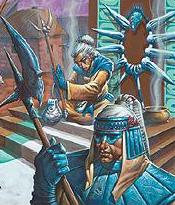
The
great Rathi plot instigator, or
perhaps someone else in disguise?
perhaps someone else in disguise?
chains.
His ‘captors,’ however, will actually be human allies dressed
up
as
Rathi soldiers, led by the formidable Lin Sivvi (who apparently can
pass as a believable man). Eladamri has his allies swear to fight on
if he doesn’t return – the rebellion is for the free people on
Rath, and is not just about him.
The Oracle is a mysterious figure. Before, she named Gerrard as Korvecdal, and now Eladamri. She appears and disappears seemingly at will, and never speaks the plain truth. But she knows much, and her words always instigate others into action. This has led some to theorize that she is, in fact, Urza in disguise – we know he has been interfering with Rath in at least some small way. This theory is intriguing, and not directly discounted by anything I’ve read, though how Urza would be as certain of his prophecies as the Oracle is is difficult to say. However, it could be believably done, and would help explain why Urza is so distracted during Pro…, that is, in the next “book.”
Belbe fears Crovax, and hates him. She knows he is the strongest candidate – indeed, the only real candidate. Yet, she wants to hurt him, to destroy him. She knows that, if named, Crovax would slowly but inexorably destroy every living thing on Rath, and anywhere else he could touch. And the more he kills, the stronger he becomes – she realized after the massacre that whenever he is around death, he grows more powerful. Ertai repeatedly asks her why she does not simply kill Crovax – because she must put the best possible candidate on the Rathi throne. It is her purpose. It is why she was created, why she existed. Ertai tells her to exist for something else, for herself. Belbe calls this weak – the needs of the whole race must be put over the individual. Ertai replies, they are of the same race – she has no common cause with her overlords. That ends the conversation, but before things get intimate, Belbe withdraws – she has a lens within her, a device that sends everything she sees and does back to her masters. Ertai cannot damage it or even understand it, but he thinks he can at least turn it off. They then spend several hours on Volrath’s bed without the company of their clothing, until Ertai falls asleep from exhaustion.
Crovax shows up afterward – perhaps even during, though if so he remained silent. He mocks Ertai, trying to goad him into a fight, pointing out that Ertai may have be shown unexpected favor. Belbe insists that she shall consider leadership abilities only, and not “biological prowess,” but cedes a date for naming the next Evincar. In two days, at midday, the fate of Rath will be decided. Crovax leaves, satisfied, and Ertai quickly follows suit – as he says, the final exam is in two days. Crovax orders his cronies to be prepared – in two days time, he will become Evincar, one way or another.
Ertai has had a profound effect on Belbe. Why can’t she live for her own sake? Crovax killing those innocent people to sate his own thirst for blood – how was that different from the Dark Lord’s plans for Dominaria? She realizes, suddenly, that it isn’t, and decides to do something about it. She tampers with the flowstone generator, decreasing its output to 50% -- if she modifies things properly, the planar overlay will not occur at all. Her masters would fight back, but some simple modifications in the makeup of Rath – with Ertai’s help – could make it as uninhabitable for them as Phyrexia is for normal humans. The rebels could be negotiated with, and Rath governed by law instead of dread. If only… if only Crovax weren’t around.
As for himself, Ertai knows he has no chance against Crovax. That he can manipulate flowstone at all is admirable, but his ability has plateaud – the best he can hope for now is to survive, maybe even escape. But to where? – he considers Dominaria rightly hosed in the coming war. All he really wants now is to escape, and live out the rest of his so-very-promising life. With Belbe.
Eladamri’s plan works swimmingly – the Stronghold is abuzz with news of the rebel leader’s capture. He is brought to the throne room by Greven, where Belbe and Crovax wait. One look at Belbe sets Eladamri into a perfect rage – to have his daughter, first murdered, then turned into this Phyrexian abomination! His assault on Belbe is so unexpected none of the soldiers respond, while Greven and Crovax watch to see what develops – Eladamri’s allies are actually the first to intercede. He is led away to be interrogated – but Belbe insists that he not be killed, and further, that her decision be put off until the following morning so she can take the news of his capture into consideration. Crovax threatens her at first, then accepts this when she points out he cannot become Evincar without her word. At least, he accepts it outwardly – but manages to capture Ertai with the help of some cronies.
Belbe is tired of Crovax’s arrogance, his bullying. If she can convince Greven to support her, she’s ready to name Ertai, and use a special set of Phyrexian weapons to back up her decision. Before she can, Crovax attempts a coup with the threat of ending Ertai’s life. After a brief but violent fight, Belbe submits – she will name Crovax Evincar, but not until tomorrow, when a broken Eladamri will be available to show their overlords as well. Crovax accepts this, taking Ertai along as collateral. Belbe can offer no further resistance – it seems Crovax has won. Nevertheless, she goes to Greven, who Crovax has been systematically tormenting through his control rod at every chance. Greven refuses to help – Crovax is too powerful, and his loyalties, he says with regret, are otherwise committed.
The Oracle is a mysterious figure. Before, she named Gerrard as Korvecdal, and now Eladamri. She appears and disappears seemingly at will, and never speaks the plain truth. But she knows much, and her words always instigate others into action. This has led some to theorize that she is, in fact, Urza in disguise – we know he has been interfering with Rath in at least some small way. This theory is intriguing, and not directly discounted by anything I’ve read, though how Urza would be as certain of his prophecies as the Oracle is is difficult to say. However, it could be believably done, and would help explain why Urza is so distracted during Pro…, that is, in the next “book.”
Belbe fears Crovax, and hates him. She knows he is the strongest candidate – indeed, the only real candidate. Yet, she wants to hurt him, to destroy him. She knows that, if named, Crovax would slowly but inexorably destroy every living thing on Rath, and anywhere else he could touch. And the more he kills, the stronger he becomes – she realized after the massacre that whenever he is around death, he grows more powerful. Ertai repeatedly asks her why she does not simply kill Crovax – because she must put the best possible candidate on the Rathi throne. It is her purpose. It is why she was created, why she existed. Ertai tells her to exist for something else, for herself. Belbe calls this weak – the needs of the whole race must be put over the individual. Ertai replies, they are of the same race – she has no common cause with her overlords. That ends the conversation, but before things get intimate, Belbe withdraws – she has a lens within her, a device that sends everything she sees and does back to her masters. Ertai cannot damage it or even understand it, but he thinks he can at least turn it off. They then spend several hours on Volrath’s bed without the company of their clothing, until Ertai falls asleep from exhaustion.
Crovax shows up afterward – perhaps even during, though if so he remained silent. He mocks Ertai, trying to goad him into a fight, pointing out that Ertai may have be shown unexpected favor. Belbe insists that she shall consider leadership abilities only, and not “biological prowess,” but cedes a date for naming the next Evincar. In two days, at midday, the fate of Rath will be decided. Crovax leaves, satisfied, and Ertai quickly follows suit – as he says, the final exam is in two days. Crovax orders his cronies to be prepared – in two days time, he will become Evincar, one way or another.
Ertai has had a profound effect on Belbe. Why can’t she live for her own sake? Crovax killing those innocent people to sate his own thirst for blood – how was that different from the Dark Lord’s plans for Dominaria? She realizes, suddenly, that it isn’t, and decides to do something about it. She tampers with the flowstone generator, decreasing its output to 50% -- if she modifies things properly, the planar overlay will not occur at all. Her masters would fight back, but some simple modifications in the makeup of Rath – with Ertai’s help – could make it as uninhabitable for them as Phyrexia is for normal humans. The rebels could be negotiated with, and Rath governed by law instead of dread. If only… if only Crovax weren’t around.
As for himself, Ertai knows he has no chance against Crovax. That he can manipulate flowstone at all is admirable, but his ability has plateaud – the best he can hope for now is to survive, maybe even escape. But to where? – he considers Dominaria rightly hosed in the coming war. All he really wants now is to escape, and live out the rest of his so-very-promising life. With Belbe.
Eladamri’s plan works swimmingly – the Stronghold is abuzz with news of the rebel leader’s capture. He is brought to the throne room by Greven, where Belbe and Crovax wait. One look at Belbe sets Eladamri into a perfect rage – to have his daughter, first murdered, then turned into this Phyrexian abomination! His assault on Belbe is so unexpected none of the soldiers respond, while Greven and Crovax watch to see what develops – Eladamri’s allies are actually the first to intercede. He is led away to be interrogated – but Belbe insists that he not be killed, and further, that her decision be put off until the following morning so she can take the news of his capture into consideration. Crovax threatens her at first, then accepts this when she points out he cannot become Evincar without her word. At least, he accepts it outwardly – but manages to capture Ertai with the help of some cronies.
Belbe is tired of Crovax’s arrogance, his bullying. If she can convince Greven to support her, she’s ready to name Ertai, and use a special set of Phyrexian weapons to back up her decision. Before she can, Crovax attempts a coup with the threat of ending Ertai’s life. After a brief but violent fight, Belbe submits – she will name Crovax Evincar, but not until tomorrow, when a broken Eladamri will be available to show their overlords as well. Crovax accepts this, taking Ertai along as collateral. Belbe can offer no further resistance – it seems Crovax has won. Nevertheless, she goes to Greven, who Crovax has been systematically tormenting through his control rod at every chance. Greven refuses to help – Crovax is too powerful, and his loyalties, he says with regret, are otherwise committed.
Quote from Nemesis, page 236 »
“I’m not free to act, Excellency[…] I never have been. Though I command armies and the flag on Predator’s bridge is mine, I do not have command of myself. I’m sorry.”
Time is growing short, and Belbe is fast running out of options. But Sivvi and the others continue their mission, oblivious to the political situation. Her party manages to board the Predator, but despite surprise and utter daring, are unable to finagle a way to seriously damage the ship. The alarm sounds, and they flee into the fortress. Below, Greven has tortured Eladamri mercilessly, to no avail – the elf has not even cried out. Greven at length gives up the interrogation, respecting Eladamri’s perseverance, and wishing for his enemy an honorable death. Alarms call him away from the interrogation, and he leaves Eladamri tied up in his cell. The battered elf manages to cut his bonds, splint his wounds, and escape. In an attempt to cause
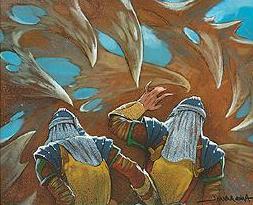
Sivvi’s
troops find, as Gerrard did
in Stronghold, that the
Phyrexian
citadel is not tourist friendly.
further
trouble for his enemies, he looks to nearby cells for potential help,
finding a thin Dal woman – a redhead named Takara. A few of
Eladamri’s soldiers join them, abandoning their mission once the
alarms began. Takara suggests they go to ground in the map room –
it is used only by the Evincar, and even then seldom. There, she
explains
what
she knows of the Phyrexians plans – Dominaria is the beautiful
world the dark masters of Rath wish to conquer, and, to use Takara’s
metaphor, Rath is the knife at Dominaria’s throat. Sivvi’s group
fights its way to Eladamri as well, but now the depleted rebels must
somehow escape.
Meanwhile, Crovax’s coronation finally comes, after a desperate but futile series of delays. But before Belbe can name Crovax, Greven steps forward with another man, who calls Crovax an usurper. Crovax tries to flowstone him away, but the newcomer can control the material as well – in fact, better. The man, whom Greven helped smuggle back into the fortress, is none other than Volrath, the absent Evincar himself, returned from his jaunt to Mercadia to reclaim what is his. Even Greven prefers this old tyrant to the new.
Belbe takes this last chance given her – she announces that Crovax and Volrath shall have a death match, the victor of which will be indisputably named Evincar. The two fight mercilessly – as is to be expected – with Volrath having the initial upper hand in skill and experience. However, Crovax proves a much more difficult opponent than Volrath expected, teleporting out of a death stroke to slice open the shapeshifter’s back. Volrath fights back with a wounding attack of his own that sends Crovax sprawling into the crowd – where he starts killing random courtiers indiscriminately to replenish his strength. Ertai arrives, substantially hurt by Crovax but still breathing, and assesses the situation. Volrath has skill, to be sure, and though evil would be less deadly than Crovax, yet the simple fact is that Crovax can replenish his strength indefinitely with the lives of those around him. Volrath cannot win. Seeing this, Ertai decides to try to curry favor with the inevitable winner. At a critical moment in the fight, Ertai turns Volrath’s attack and allows Crovax to defeat the fallen Evincar. Before Volrath can be killed, word comes that the rebels have barricaded themselves in the Dream Halls. Belbe finally does her duty – she names Crovax Evincar of Rath. Volrath is taken prisoner, and Evincar Crovax leaves to deal with the infiltrators, with Belbe in tow.
Belbe manages to convince Crovax to allow her to negotiate with the rebels in person, as the Dream Halls are virtually impregnable and driving them out would be difficult, and there is no other way out. Or so Crovax thinks – Belbe has hidden her portal there, and offers to let the rebels escape, though there it can only handle a few of them. Eladamri realizes now what the Oracle meant in her prophecy – he asks to be sent to Dominaria, to help them prepare for the invasion to come.
Ertai, after healing himself again, arrives, frantic to get into the Dream Halls and use the portal within. He tells Greven about the portal, hoping to stop her from using it for the rebels and not for their own escape. The attack on the doors resumes while Belbe programs the portal within. As soon as Dominaria appears, Takara runs through of her own accord. Eladamri pushes Sivvi through, then turns to Belbe, and without warning, throws the contents of a vial at her – the remainder of the poison found at his daughter’s bedside. Belbe’s death comes quickly, and Eladamri passes through the portal right before the Rathi’s arrive. The device had a maximum weight limit, precluding any further pursuit of the rebels. They, at least, escape Crovax’s wrath.
Perhaps Belbe’s death is a merciful escape as well – she does not have to see how Crovax rules. Greven is severely punished for his aid to Volrath, and spared only because of his part in the coming war. Ertai’s heart is shattered, leaving him only with the most basic, empty will to live – the same thing that has maintained Greven il-Vec for so many years. For his unsolicited help in defeating the former Evincar, Crovax grants Ertai a life of servitude, a life like Greven’s, but a life at least. Ertai agrees, and, like Greven, is reshaped to fit his new role.
Crovax stages an elaborate funeral for Belbe, requiring attendance of every major noble in the Stronghold. Besides the honorary burning of Belbe’s body, there is a further display – in fact, the true reason everyone is compelled to attend. Volrath – Vuel, now, without all his Phyrexian implants – is brought before the assemblage, defeated but, somehow, unbroken. Anyone showing respect to the defeated is noted and killed later. Ertai, loyal lapdog of Rath, gets the honor of executing the traitor, Vuel. Gerrard’s former blood-brother is injected with flowstone, and Ertai gives it a simple command: disassemble. Bit by bit, the human body of the former Evincar simply falls apart.
Meanwhile, Crovax’s coronation finally comes, after a desperate but futile series of delays. But before Belbe can name Crovax, Greven steps forward with another man, who calls Crovax an usurper. Crovax tries to flowstone him away, but the newcomer can control the material as well – in fact, better. The man, whom Greven helped smuggle back into the fortress, is none other than Volrath, the absent Evincar himself, returned from his jaunt to Mercadia to reclaim what is his. Even Greven prefers this old tyrant to the new.
Belbe takes this last chance given her – she announces that Crovax and Volrath shall have a death match, the victor of which will be indisputably named Evincar. The two fight mercilessly – as is to be expected – with Volrath having the initial upper hand in skill and experience. However, Crovax proves a much more difficult opponent than Volrath expected, teleporting out of a death stroke to slice open the shapeshifter’s back. Volrath fights back with a wounding attack of his own that sends Crovax sprawling into the crowd – where he starts killing random courtiers indiscriminately to replenish his strength. Ertai arrives, substantially hurt by Crovax but still breathing, and assesses the situation. Volrath has skill, to be sure, and though evil would be less deadly than Crovax, yet the simple fact is that Crovax can replenish his strength indefinitely with the lives of those around him. Volrath cannot win. Seeing this, Ertai decides to try to curry favor with the inevitable winner. At a critical moment in the fight, Ertai turns Volrath’s attack and allows Crovax to defeat the fallen Evincar. Before Volrath can be killed, word comes that the rebels have barricaded themselves in the Dream Halls. Belbe finally does her duty – she names Crovax Evincar of Rath. Volrath is taken prisoner, and Evincar Crovax leaves to deal with the infiltrators, with Belbe in tow.
Belbe manages to convince Crovax to allow her to negotiate with the rebels in person, as the Dream Halls are virtually impregnable and driving them out would be difficult, and there is no other way out. Or so Crovax thinks – Belbe has hidden her portal there, and offers to let the rebels escape, though there it can only handle a few of them. Eladamri realizes now what the Oracle meant in her prophecy – he asks to be sent to Dominaria, to help them prepare for the invasion to come.
Ertai, after healing himself again, arrives, frantic to get into the Dream Halls and use the portal within. He tells Greven about the portal, hoping to stop her from using it for the rebels and not for their own escape. The attack on the doors resumes while Belbe programs the portal within. As soon as Dominaria appears, Takara runs through of her own accord. Eladamri pushes Sivvi through, then turns to Belbe, and without warning, throws the contents of a vial at her – the remainder of the poison found at his daughter’s bedside. Belbe’s death comes quickly, and Eladamri passes through the portal right before the Rathi’s arrive. The device had a maximum weight limit, precluding any further pursuit of the rebels. They, at least, escape Crovax’s wrath.
Perhaps Belbe’s death is a merciful escape as well – she does not have to see how Crovax rules. Greven is severely punished for his aid to Volrath, and spared only because of his part in the coming war. Ertai’s heart is shattered, leaving him only with the most basic, empty will to live – the same thing that has maintained Greven il-Vec for so many years. For his unsolicited help in defeating the former Evincar, Crovax grants Ertai a life of servitude, a life like Greven’s, but a life at least. Ertai agrees, and, like Greven, is reshaped to fit his new role.
Crovax stages an elaborate funeral for Belbe, requiring attendance of every major noble in the Stronghold. Besides the honorary burning of Belbe’s body, there is a further display – in fact, the true reason everyone is compelled to attend. Volrath – Vuel, now, without all his Phyrexian implants – is brought before the assemblage, defeated but, somehow, unbroken. Anyone showing respect to the defeated is noted and killed later. Ertai, loyal lapdog of Rath, gets the honor of executing the traitor, Vuel. Gerrard’s former blood-brother is injected with flowstone, and Ertai gives it a simple command: disassemble. Bit by bit, the human body of the former Evincar simply falls apart.
Quote from Nemesis, Page 311 »
Vuel landed face upward. As his ears and nose slid from his face, as his teeth bubbled out of his mouth on the last breath from his lungs, he saw the ever-gray sky of Rath change to perfect, cloudless blue. It was the sky of Dominaria, and Vuel, son of Kondo, had returned home at last.
Vuel is disassembled to the last molecule, and all that is left of Belbe is her fire-warped Phyrexian endoskeleton. Ertai wades into the ashes, retrieving her still-warm skull, then scurries away under the stars of his homeworld after finding the Phyrexian lens that, too, survived the flames.
So ends the bleakest chapter of Magic story history – even The Dark was not so depressing as this. This is one of the few books I’ve read in the Magic novel line I actually consider to have literary value – the inevitable, systematic destruction of hope portrayed in this book is just the sort of thing lit professors enjoy. Everyone we loved was destroyed, everyone we hated won, and the world was coming to an end. The stakes for the coming invasion were set supremely high, and Nemesis showed that the good guys didn’t necessarily have to win.
Shannon Rezendes, 2005