I'm pleased to announce that an early novel written by Tonya Cook and me, RED SANDS, is now available from Amazon in a new Kindle edition. First published in 1988 and long out of print, RED SANDS was nominated for the World Fantasy award that year (didn't win, alas). This newly digitized edition also features an afterword by me describing the origins of the novel and how it was working with TSR in those early days. In the near future, I hope to make RED SANDS available as an audio book through Audible.
Wednesday, May 22, 2024


Tuesday, March 19, 2024
From ParaScope: Secrets of the Pyramids (1996)
Here's another article from the now defunct online magazine PARASCOPE, once part of America Online's Greenhouse Project. This piece I wrote for Donald Trull's department "Enigma," which dealt with various Fortean and ostensibly paranormal phenomena. Modern comments are in red.
Secrets of the Pyramids
by Paul B. Thompson
Nebula Editor
[Obsolete email address deleted]
Few monuments of the ancient world exude as much mystery, wonder and romance as the pyramids of Egypt. For centuries after the tongues of the ancient Egyptians were stilled, travelers spoke in awe of the silent mounds of stone that dot the western shore of the Nile. Prior to the decipherment of hieroglyphics in the early nineteenth century, very little authentic information could be had about the pyramids. Much of what the world knew came from sources like the Greek historian Herodotus (5th century BC), who described the pyramids of Giza as the tombs of the Pharaohs Cheops, Chephren, and Mycerinus. [These were Greek forms of the Egyptian Khufu, Khafre, and Menkaure.]
He was right as far as that went, but other details Herodotus certainly got wrong -- that the pyramids were built using wooden cranes, that Cheops' daughter prostituted herself in order to obtain stone for her own pyramid (one block per customer... ), or that a subterranean canal conducted water from the Nile to the Great Pyramid, creating an underground island on which Cheops was buried, etc. These tales, like those heard today at any tourist trap, were likely made up to impress travelers by sharp local guides eager for baksheesh.
The fact is, today we know a great deal about the pyramids, who built them, and how. Some details remain murky -- understandable after 4,700 years -- but the religious, cultural, and engineering development of the Egyptian pyramid is well understood after two centuries of scientific study.
In the first two dynasties of unified rule, Egypt's royalty were buried under large mud brick structures known as mastabas (Arabic for "bench"). Mastabas were rectangular mounds whose walls sloped slightly inward. As the deceased pharaoh was as divine dead as he had been when living, shrines were built adjoining the mastaba for worship of the dead god-king. This practice would continue after the Egyptians ceased building royal mastabas and began building pyramid tombs; every finished pyramid has an associated funerary temple, which in ancient times was often considered as impressive as the pyramid itself.
By the dawn of the IIIrd Dynasty (circa 2700 BC), Egypt was sufficiently advanced and prosperous to support ever larger building projects. King Zoser, first monarch of the IIIrd Dynasty, decided to show off his wealth and success by constructing for himself the most imposing mastaba yet. He was fortunate to have as his architect Imhotep, one of the first identifiable geniuses of history. Imhotep designed an impressive mastaba for Zoser, but it wasn't grand enough for his royal master. While it was being enlarged, Imhotep had a design breakthrough: he decided to pile other, slightly smaller mastabas atop the original one. Moreover, Zoser's tomb would be wrought in stone, not mud brick. Zoser must have been delighted, for study of his tomb shows it was recast once more with six ascending levels instead of four. The result was the first pyramid in Egypt, known as the Step Pyramid. (The name is purely informational; Zoser's tomb resembles a set of steps.) In its final form the Step Pyramid dwarfed all previous royal tombs, as it was 140 meters long, 118 meters wide, and sixty meters high. An elaborate walled enclosure encompassed the pyramid and mortuary temple into a sacred precinct where Zoser could be revered for all time.
Is the pyramid shape significant, other than as the inspiration of architect Imhotep? Whatever their advances, the Egyptians were limited in what they could build, both by the materials they possessed and the technology they understood. They did not know how to build domes or arches, as the Greeks and Romans used later in their monuments. The pyramid is a simple geometric solid, the only shape other than rectangles the Egyptians could build with the materials and methods they knew.
On the other hand, the pyramid did acquire religious significance. The royal cult was closely linked to worship of the sun god Re. A hieroglyph developed at the dawn of Egyptian history depicts the sun as a phoenix perched atop a pyramid-shaped object called a benben. This benben has been taken to represent the sun's rays spreading to the earth, so a definite symbolic link can be found between the solar cult and the tombs of the pharaohs, the sun god's son on earth.
Considerable speculation has been made about how the Egyptians built their pyramids, from Herodotus's tales of cranes to modern claims of extraterrestrial aid or occult levitation. While interesting, these paranormal theories are unnecessary to explain the pyramids' construction. When we examine the existing pyramids, from Zoser's down to the last royal pyramid tombs of Dynasty XIII (nearly 1,000 years apart), we see different plans, different types of construction, and different materials used. But the pyramids of Dynasties III and IV -- the greatest ones of all -- were built of stone blocks. How did the Egyptians raise all those heavy stones to the heights of the pyramid's peak? What motive force did they use?
As it turns out, they used the simplest methods available: ramps and the muscles of many men. How do we know this? The Egyptians themselves left us the evidence.
Following the reign of the mighty Pharaoh Zoser came an ephemeral king named Sekhem-khet. Like his predecessor, Sekhem-khet resolved to erect a great step pyramid for himself at Saqqara. Unfortunately, Sekhem-khet's reign was brief (six years), and his pyramid wasn't finished. The site was abandoned and gradually covered by the desert. It was not until 1951 that archeologist Mohammed Zakaria Ghoneim found Sekhem-khet's "lost" pyramid. As Ghoneim cleared the site he discovered, to his delight, that long ramps of packed earth and rock were still in place along the sides of the unfinished tomb! Here, as plain as could be, was at least one version of how the Egyptians built their pyramids.
To move the stone blocks into place, the Egyptians used neither wheels nor draft animals, but sledges hauled by men. In some tomb paintings there are scenes of oxen drawing blocks from a quarry, but animals weren't precise enough to use on the pyramid itself. Fewer than a dozen men could manhandle a pyramid building block into place; this can be deduced from a famous scene from the tomb of XIIth Dynasty noble Dhutihotep, in which 172 men drag a colossal statue, many times larger than any pyramid block. The essential ingredient to building a pyramid therefore was steady, dedicated labor and a high degree of social planning. And money -- lots of money, in the form of food and shelter for the pyramid workers. [The pyramid workers were not oppressed slaves, but hired laborers who worked on monuments during the flood season, when their fields were inundated. A few were professional builders--pyramids were their life.]

From the tomb of Dhutihotep: how to move a
colossus
As the Egyptians had their successes, so did they have their failures. Sekhem-khet's successor, Kha-ba, is believed to have built the so-called "Layer" pyramid at Zawiet el Aryan. Here the Egyptians tried a different form of construction, layering vertical piles of stone into a step pyramid shape. It didn't work, and the Layer pyramid today is a low mound of rubble, whereas Zoser's step pyramid still stands at Saqqara.
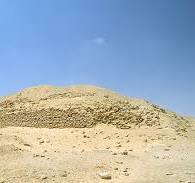
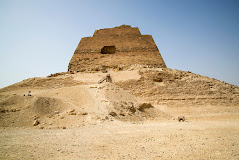
The Layer Pyramid; the Pyramid of Meydum
The last king of Zoser's line, Hu, began his tomb as another step pyramid. Apparently Hu died prematurely, for his pyramid at Meydum was finished by his successor, Snefru. Snefru was not of Hu's line, and is considered the founder of the IVth Dynasty, the greatest pyramid builders of all time. Snefru must have had a visionary architect of his own, because Hu's pyramid was finished not with stepped sides, but as a smooth solid, the first true pyramid. Hu's tomb at Meydum no longer looks like a classic pyramid, however. The lower courses have fallen away, revealing the core "steps." Hu's pyramid now resembles a square tower.
One claim often made by theorists who believe the Great Pyramid at Giza has powers and attributes beyond the mundane is that the angle of the pyramid's sides is of special mystical significance. Khufu, son of Snefru, built the Great Pyramid with sides angling up at 51 degrees, 52 minutes. Yet there is no standardization of slope angle among the other pyramids. If the angle of the Great Pyramid were of such cosmic significance, the Egyptians surely would have repeated it in subsequent pyramids -- but they didn't. Virtually every shade of angle from as shallow as 43 degrees to as steep as 65 degrees occurs on pyramids other than Khufu's.
We can even see evidence of miscalculation by the ancient architects as they attempted to build beyond their skills. Snefru's first pyramid at Dahshur, known as the "Bent" pyramid, has a compound angle because the builders changed it halfway through the job. The original angle was 54 degrees, 31 minutes had to be lessened to 43 degrees, 21 minutes when the architects realized the weight of the upper part of the building would crush the burial chamber of Snefru inside. Oops!

The Bent Pyramid
Another common objection voiced by those who don't believe the Giza pyramids were tombs is that their interiors are so plain and undecorated, with simple stone tubs instead of elaborate sarcophagi. In fact, before the VIth Dynasty (2340 BC) tombs were not heavily carved or decorated. The common vision of sumptuous funerary equipment stems from the treasures found in New Kingdom tombs, like Pharaoh Tutankhamen's. Fourteen hundred years separates Khufu from Tutankhamen, the same distance between Queen Elizabeth II and Emperor Justinian of Byzantium. Customs evolve, art changes, and economies shrink and grow considerably in fourteen centuries.
It's easy to observe a modern economic phenomenon at work in the history of pyramid building: inflation. Through the last of the Giza pyramids (that of Pharaoh Menkaure), the use of solid stone blocks in the substructure persisted. As the IVth Dynasty faded into the Vth, not even the god-kings of the Nile could afford to build so hugely in costly stone. Even long-lived, powerful pharaohs like Dedkare Isesi (Vth), Teti (VIth), and Merenre (VIth) had to settle for tombs made of stone shells filled with rock, rubble and sand. These hard-shell pyramids might have looked impressive when new, but once the fine stone casing broke, the pyramids collapsed like a broken hourglass. The burial chambers, cut into bedrock below the pyramids, survived. On the walls of VIth Dynasty tombs we first find the famous Pyramid Texts, poetic religious texts intended as guide and comfort to the soul of the dead monarch.

The "pyramid" of Merenre
Egypt fell into anarchy after the VIth Dynasty, and few had the power to build even shoddy pyramids. When Theban princes reunified the country under dynasties XI and XII (circa 2134 BC), pyramids tombs were built again.
The XIIth Dynasty pharaohs applied new techniques to pyramid construction. They could not afford solid stone monuments like Khufu's (inflation again), but they saw the ruin that could come to the hard-shell tombs of the VIth Dynasty. Their solution was to build stone or brick "skeletons" inside the pyramid to brace up the exterior casing. The spaces between the ribs were filled with mud brick -- cheap, but more stable than sand and rubble. The internal arrangements of XIIth Dynasty pyramids became more elaborate, and for sinister reasons. The mighty pyramids of previous eras had been plundered during the days of lawlessness. To protect the home of their eternal Ka, XIIth Dynasty pharaohs built tombs of a complexity to delight the fictional Indiana Jones -- false passages, trap doors, hidden chambers -- but no man-traps! The tomb of Amenemhet III at Hawara is the prize of this type of pyramid. Amenemhet's burial chamber was hewn from a single block of quartzite, hollowed into a rectangular box with exquisite precision and sunk into the core of the pyramid. A labyrinth of passages hides it, but even Amenemhet III's grave was eventually robbed.
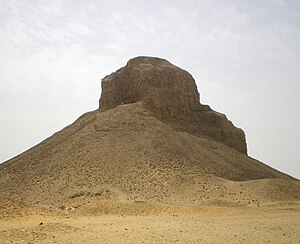
Pyramid of Amenenhet III
This fact ultimately led to the end of pyramid building. No tomb, no matter how splendid, was of any use to the pharaoh if it was plundered and his mummy profaned. In the New Kingdom, monarchs turned to remote rock-cut tombs (like Tutankhamen's) to keep their burial secure. It was to no avail. Robbers, incited by the enormous treasure available, found every pharaoh but Tutankhamen, and stripped them of their riches.
Questions remain about the ownership of some pyramids. Money for research is the biggest single impediment to finding any answers.
The pyramids are still wonders, but there is no need to mystify them. Scientific Egyptology has found many answers to their mysteries, and not once has there been a need to involve aliens, Atlanteans, or any supernatural agency. The genius of the ancient Egyptians is manifest. Why should we deny them the treasures of their art and intellect?
(c) Copyright 1996 ParaScope, Inc.
Tuesday, February 20, 2024
FIANCHETTO: Sin Conductor
Earlier in the novel Victor agrees to an interview by a famous online personality, Karasu Nohane. In an era where most actors, hosts, and reporters are AI generated talking heads, Karasu is unusual in being a real person. She's unusual in other ways, as Victor discovers.
Some notes: "vee-vee" is 2065 slang for all visual media, a combination of movie and TV. Your/World is the global audio-visual system, comprising all phone, internet, film, television, and publishing.
Victor was met at LAX by a large,
bearish fellow wearing a plaid 'Canada' T-shirt. He carried one of those Nixie
tube signs that read V/LEVENTON. Victor approached with his single overnight
bag.
"Cuervo Refugio?" he
asked.
The big guy snatched the bag out of
Victor's hand. For a moment he thought this was some heavy-handed robbery, but
Canada guy flashed an ID card with Karasu's crow logo on it. His name was
Charlie-something.
"This way," he said. His
voice was as bearish as his physique.
Ranks of self-driving cabs awaited
at the curb outside the terminal. Canada waved his PDL at them. One lit up and
whirred over to them. Victor was startled to see the label SIN CONDUCTOR in
peeling yellow letters on the side of the cab.
He pointed, puzzled. Charlie said,
"Means 'driverless' in Spanish." They got in.
The cab was a little more than a
metal box on four wheels. Two rows of hard, flat seats filled the interior,
room for four passengers. The controls up front were mounted in a painted steel
housing, looking like an armored safe. The rear of the housing bore numerous
scuffs and dents.
Mr. Canada fell heavily into the left-hand
front seat. Victor sat behind, on the right rear bench. The guy from Cuervo
Refugio promptly kicked the taxi's console with the knobby sole of one of his
black combat boots. The door closed with authority and the taxi lurched away
from the curb. Victor hadn't even buckled his seat belt yet.
With neck-snapping acceleration, the
cab injected itself into the artery of traffic passing the airport. Contrary to
endless Your/World ads about the smoothness and safety of driverless cars, the
Sin Conductor surged forward, braked hard, and changed lanes often while
surfing the wave of traffic. The electric powered box darted in and out,
playing chicken with enormous land trains, buses, and other anonymous wheeled
boxes. Charlie tried to point out landmarks as they whirled past. Victor saw
downtown highrises and the Hollywood sign, now in permanent holographic form
since the famous metal emblem was lost in the Big Shake of 2046.
Cuervo Refugio was on the northern
edge Hollywood. Every town in southern California seemed to flow into the next,
creating an endless stream of strip malls, low rise office complexes, and
pastel stucco apartment blocks.
The taxi hurtled off the highway
onto a side street. Here the buildings were plainly older, going as far back as
the 1970s. The Sin Conductor slowed as they passed a three-story brick and
structure topped with sign projectors touting Your/World channels like Mi Vida
Sexy and
Phật Và
Cơ Thể Của Bạn.
"Cuervo Refugio, third
floor," Charlie remarked. "We'll be back here tomorrow morning."
The cab hummed down the side street
to a nearby micro hotel, The Hutch. Victor saw the video sign and said,
"Isn't a hutch where rabbits live?"
"If you say so, man. Beats hell
out of me.”
He checked Victor in, and carried
his bag upstairs. Charlie left him a nano dot with codes and a link list so he
could get it touch with the studio if needed.
"When do I meet Ms.
Karasu?"
"Tomorrow, at the studio,"
Charlie said. Then he left.
The room was standard micro size,
twenty-eight square meters. Victor had stayed in a place like this when he went
to India to play NAAG. The half blank inside wall was a Your/World screen. A
Kumo utility PDL was fixed to the coffee table. Victor tapped it, then
continued exploring. It took about twenty seconds to tour the whole place. The
king size bed was hinged to the baseboard and folded into a recess. The
bathroom fixtures were nestled so closely together he could stand in the shower
and easily piss in the pot--or the sink.
The wall was beaming cheerful
scenery and upbeat music at him when he returned to the main room.
"Welcome to The Hutch! We hope
you enjoy your stay! For room service, ask for 'Room Service.' For the latest
Your/World programs and films, ask for 'Your/World.'"
Most of the people who stayed here
must be idiots, he decided. Victor muted the wall and took out his personal
PDL.
He input her address. She didn't answer. He switched to text mode and typed In L.A. Where are you? The text flashed off into Your/World's infinite stream of noise and chatter, forever lost. He waited a while for an answer. None came.
#
Victor awoke at sunrise as he often
did. Ever since he was a child, he relished the solitude of dawn. It was his
personal time in the world. In college, when most guys his age turned into
night crawlers, Victor was often in bed by eleven PM in order to greet the sun.
He went to the window and threw back
the lightproof curtains. The view faced north, and the horizon there was still
deep gray with night. The earth rotates at approximately 1,600 kilometers an
hour, so as Victor stood there, he was hurtling through space too. He
calculated it. Every minute was another 26.66 kilometers, or 444 meters per
second.
A delivery van, marked 'Sin
Conductor' on its roof, turned onto the access road behind The Hutch. It glided
up to a loading dock and disgorged four pallets of--what? Food for the kitchen?
New carpet for the foyer? From the second floor the containers were just big
tan boxes.
"Your/World on," he said.
Behind him the wall burst into operation. He muted the sound. It was a chirpy
local morning show in Spanish. Farmers in the valley were tenderly harvesting
hydroponic strawberries.
"Your/World Secret Door."
This was his porn portal. A hundred
thumbnails popped up, though at this scale each thumbnail was the size of a
dinner plate. Turning away from the window he scanned the images. There were
new vee-vees by some of his favorites, but this morning they meant nothing,
felt like nothing.
"Your/World Games, chess."
Overnight video stream from a match
for International Masters in Perth. Two grandmasters, one South African, one Finnish,
were giving commentary in an inset window. Victor closed the commentary. The
players were too slow.
"Playback 2X."
The images moved at two times speed.
The match ended after fifty-nine moves. The others dragged on.
"Playback 4X."
Table after table concluded in a
blur of hands and moving chess pieces. The day's matches ended in less than
five minutes at this speed. The last game, between an elderly Australian and a
young Ukrainian went on the longest.
"Replay. 6X."
Now the separate inset frame of
video strobed so fast it was hard to detect individual movements. The entire
game went by in eighty seconds.
"Give me tight view, table
11." That was where the Ukrainian was playing. The caption below read
KURLENKO, Y. His Australian opponent was BATTERLSEY, B.
"Play table 11, 6X."
There it was. He caught a glimpse of
it at 4X, but at six times speed the crux of the game stood out like the bullet
impact in the Zapruder film. That's where Kurlenko killed Battersley, at that
fragment of time and play.
"Playback stop."
In his mind Victor played out
hundreds of variations of how the game could have gone from that point forward.
In the two hundred third branch of possibilities he found how Battersley could
have drawn the game.
"There!" he muttered.
"Stupid shit, why didn't you shift that pawn to f6?"
The door chimed behind him. In his
mind Victor ran the game backward. Battersley, playing Black, was holding his
own until the twenty-eighth move. Kurlenko slyly pushed a knight to e6. That
was the beginning of the end.
The door chimed. Victor ordered the
PDL to open the door.
It was Charlie. This morning his
shirt read "Espaňa." His clothes got around.
"Mr. Leventon? Time to
go."
Victor was standing before the wall
screen in his underwear. He hadn't bathed or dressed. When he inquired
"Time?" the screen flashed 8:19.
He'd been absorbed in the tournament video almost two hours.
"Oh hell, give me a
minute!" He ran to the tiny puzzle box bathroom and tore back the shower
curtain.
Charlie wandered over to the mini
bar. He put two 400 ml Heineken paks in his jacket pockets and cleaned out the
packets of smoked almonds. Backing away, he frowned at the chess tournament
video, looping over and over again at six times normal speed.
"Some weird shit," he
said. He stopped the playback. Closing the chess screen, he found Secret Door
still open behind. Before he could focus on any particular thumbnail, the sound
of the shower ceased. Charlie killed the screen.
Victor emerged, towelling his hair.
He dressed rapidly in his charcoal Knyphausen suit. The strobe tie he brought
suddenly seemed gawdy and out of place. He asked Charlie what Karasu's other
male guests wore.
"Some wear ties. Some
don't."
He left the strober on the bed.
Better to look too informal than reek of geek.
"Let's roll!"
Victor grabbed his PDL and shoved it
in his coat pocket. Charlie, wearing dirty jeans, lace up b-ball shoes, and his
Espaňa shirt, shrugged and held the door for him.
Saturday mornings at this hour the
streets were quiet. Charlie had come in a hand-driven van, and he drove with
easy swings of the steering wheel through the empty streets. In short order
they arrived at the nondescript office building that held Cuervo Refugio.
Cuervo's building looked more suited
to dentists' offices or realtors, which were exactly the businesses on the
floors below Karasu's West Coast studio. Victor knew nothing about Your/World
facilities or recording studios. He'd never seen Your/World until he went to
college. Since then, his imperfect knowledge came from ancient vee-vees.
Mounting the outside staircase, Victor spotted a matte black door with a
stylized chrome crow silhouette inset in it.
Charlie's PDL unlocked the door. He
went in, calling out in his back country accent, "Comin' in!"
A petite black-haired woman
appeared, dressed in a test pattern skirt and top. The moiré pattern blinked as
she moved.
"I'm Teresa," she said,
extending a slim hand. Victor introduced himself as Charlie thumped past,
disappearing down a hallway.
The outer office resembled a
dentist's office too: cubic furniture, small Your/World screens on pivots by
each chair. On the wall facing the entrance was a life-size video marker of
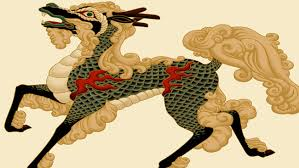
Karasu Nohane, which slowly alternated with the logo of Kirin Studios. It was a
unicorn-like creature with a goaty face and chin beard. Victor knew Kirin as a
brand of Japanese beer, but 'chi-rin' was also the name of a one-horned
creature from Asian mythology.
Without being called, Charlie
emerged from the back with two demitasse of blistering hot coffee. Handing them
over, the big guy retreated again.
"My apologies for interrupting
you this morning," Teresa said pleasantly. Blowing on his coffee, Victor
asked what she meant. "You were playing chess."
How did she know? He asked as much.
She smiled. "Charlie wears a
Your/World micro-cam, 24/7. It's the coming thing." Micros were no larger than shirt buttons, and were often disguised
that way. Lapel cams were even smaller.
Victor stared. Everything Charlie
saw went out on the network? Even his underwear-clad catharsis?
"Don't worry, we don't
necessarily feed live to Your/World," Teresa said. He noted the important
word 'necessarily.' Silently Victor resolved to be more careful.
A third Cuervo Refugio staffer
joined them, Ramón, Karasu's stylist. He and Teresa made casual conversation
for a few minutes, then the woman set down her cup and said, "Would you
like to see the studio?"
He followed them down a hall. The
actual studio set was an old office layout modified into a large, open space.
The ceiling wasn't high, and there was no obvious special lighting. On the
ceiling there were four interlaced curving metal tracks whose purpose Victor
did not recognize. Along the room's long axis were two mid-century modern
swivel chairs. The carpet was dead black. Behind the chairs the converging
walls were covered completely by two of the largest Your/World screens Victor
had ever seen.
"You'll sit here," Teresa
said, indicating the farther chair. "Karasu-san will sit there. Be sure to
look at her when she speaks."
"Where are the cameras?"
"They'll be on those tracks
above you," Ramón said.
The long screen came to life. It
showed not the blue screen of an empty signal, but settled in as black as the
carpet. Faintly lighter vertical bars marched slowly along its length. A
hundred point digital clock readout appeared: 09:22:07 PDST 04/24/65. The seconds readout climbed steadily.
Ramón had Victor sit in his designated chair.
He took a white leather case from his coat pocket and snapped it open. Wielding
an aerosol tube no bigger than Victor's finger, Ramón spritzed some kind of
preparation on his forehead, nose, and cheeks. The stylist stood back and
pointed his own PDL at Victor, whose eyes were still shut.
Four steps away, in the center of
the long room, Teresa said, "Get his chin."
Victor opened his eyes. Twisting in
the cup-shaped fiberglass chair, he saw himself projected on the huge screen
behind him. At this size he looked like Big Brother in a revival of 1984. Ramón's spray prep had rendered
his face smooth and pore-less, except for his chin.
Ramón turned his face toward him
again. "Close your eyes." Victor felt a slight warming sensation below
his lips. Teresa pronounced herself satisfied.
Victor wanted to see what he looked
like now, but Ramón shut off his PDL feed and the wall returned to black bands
and the clock display. 09:37:41 PDST.
Charlie came in with three
contraptions resting in the crook of his left arm. They resembled jointed rods
of black plastic, each tipped with a clear 10 mm bead.
"What's the setup?"
Teresa indicated the second, third,
and fourth metal tracks in the ceiling. Charlie raised one of the spidery
devices, and it clicked into the second track. He did the same at the remaining
two metal arcs.
"Are those the cameras?"
asked Victor.
"Uh-huh.” Teresa used her PDL
to test them. Though the hanging rods had no obvious optical device on them,
when she tested the first one, a red LED glowed on the tip, and Victor's
profile appeared on the wall behind him. She activated each one in turn.
"Good." She left the
camera on Victor's far left on and made some notations on a scripter.
Their devices chimed in unison.
Unconsciously Ramón, Teresa, and Charlie stood up straighter.
"She's here," said Ramón.
"How do I address her?"
Victor asked. "Ms. Karasu? Karasu-san?"
"Anything but Nohane,"
Teresa said.
There were voices in the outer
office. The door had opened. Ramón and Teresa hurried out. Charlie checked some
things on his PDL.
"Is she that scary?"
Victor asked quietly.
"She's the boss."
"Any advice?"
He looked up from his device.
"Don't be a dick."
A stir in the outer office presaged
Karasu's entrance. Ramón bustled in, hands in motion as he described another
project they were working on. Then Karasu Nohane entered.
She was very tall, as common gossip
said. Her glossy black hair was cut chin length and free of any colored
highlights. She wore a Cossack smock of mustard-colored silk over ballooning
black capris. As was the style, her legs were bare, and she wore pleekays:
stick-on leather foot pads. Her legs were smooth and rather pale. From four
meters away, aside from her height, Victor saw nothing else unusual about her
appearance. He stood and slowly approached.
Teresa said, "Ma'am, this is
Victor Leventon."
Karasu extended a long hand.
"Yes, I recognize him from his videos."
Lauren Bacall, he mused. A certain
contralto, her voice was not as deep as her size led him to imagine. She was at
least twenty cm. taller than Victor.
"It's an honor," he said,
shaking her hand. Karasu's nails were enameled blue steel.
"I am 198 centimeters
tall," she said, gazing directly into Victor's eyes. Hers were as black as
onyx.

He didn't how to reply. She laughed
lightly. "That's what everyone wants to know the first time they meet me!
Not two full meters, as the gossips say. One hundred ninety-eight centimeters!
Remember that!"
She was smiling, but Victor had the
distinct impression he had better
remember.
Karasu extended a hand, bidding
Victor take his seat. The wall read 09:51:33.
The famous
Your/World personality sat opposite him. Teresa discreetly adjusted her chair
so that she did not tower too much over her guest. Ramón had his spray out, but
he professed the boss didn't need it. Karasu checked herself with the stylist's
PDL. Tersely she ordered him to tidy up the backs of her hands and the base of
her throat. While this happened, Victor noted the faint tracing of an IR tattoo
on her upper left arm. Under white light it was almost invisible. Kata-kana, he
thought. Karasu? Crow.
"Mr. Leventon," she began
as Ramón backed out of the cameras' line of sight.
"You can call me Victor."
She smiled fleetingly. "It's
better I not. Now, Mr. Leventon, when did you start playing chess?"
Had the interview started? Victor
looked left and right. Teresa, Ramón, and Charlie were present, off camera,
silent as statues.
Karasu patted his hand on the arm of
his chair.
"I'm over here, Mr.
Leventon." Her face was a friendly mask, but her manner was imperious.
"I first played chess when I
was six."
"Was that at Fysikós
Farm?"
The name pierced him like a
hypodermic. "Yes."
"What was it like on the
farm?"

He flexed his fingers. "Quiet.
We had no Your/World there, not even recorded vee-vees."
"Sounds lonely and dull."
"It wasn't so bad. There were
other kids to play with--"
"Play chess with, you
mean?"
He shrugged. "Sometimes."
"You mother, Frances Clarke,
ran the place, didn't she?"
Where was she going with this? He
shifted from star-struck mode to analyzing the possibilities.
"My mother was one of several
people on the council that guided the operation of Fysikós Farm."
"But she was in charge, wasn't
she?"
He met Karasu's hard jet eyes.
"Not as much as she thought."
Karasu sat back, folding her long
hands in her lap.
"To what do you attribute your
remarkable abilities, Mr. Leventon? Was it the deprived atmosphere of Fysikós
Farm, or something else?"
Have
you stopped beating your wife?
"I wouldn't call life at the
farm deprived. Insulated, maybe, but it was not a lab for creating chess
prodigies--or prodigies of any kind, for that matter."
"Do you have any contact with
people from Fysikós now?"
That question hung unanswered for a
long time. In the background Teresa stirred nervously, hand to her mouth.
"I haven't been back to the
farm since 2048."
Karasu crossed her legs. Composing
herself to look sensitive and concerned, she asked, "Did you attend your
mother's funeral?"
Queen's
Gambit.
Unblinking, he replied, "No. No
one could. Her body was lethally contaminated with plutonium. She and the
others who died at the Washington Monument are housed in a government nuclear
waste facility in Utah."

The wall read 10:00:00. There was a
blare of music from Holst's The Planets, the
'Jupiter' movement.
"We're recording in
five--four--three--" Charlie held up two fingers, then one.
A masculine recorded voice declared
in rapid Japanese, "Karasu Nohane! Now she is here!"
The wall image behind them hardened
into a stylized arrangement of Staunton chess pieces. The LED on camera three
glittered. Karasu looked directly at the light and spoke in quick, breathy
Japanese. Off camera, Ramón held up a scripter for Victor that displayed a
translation of what the host was saying.
Victor read: "Good morning,
good day, good night! I am Karasu Nohane. It's an honor to be watched at this
time.
"At this moment I am here with
Mr. Victor Leventon, an American engineer who has set the world of chess and
artificial intelligence into great turmoil! He has not invented a new chess
playing machine, oh no. Mr. Leventon is a chess playing machine! He has
beaten several previously invincible AIs in China, India, and Turkey. At this
moment, he is poised to challenge the great Russian device ARAKHNA. If he can
defeat it, only one thing stands between him and the world chess championship—the
awesome Swiss machine FORT!"
Karasu turned to Victor, dropping into English.
"Mr. Leventon, it is very
interesting to have you here!"
"Thank you."
"The world chess championship
has been held by artificial intelligences for more than thirty years. Why is
that?"
Gambit
accepted.
Victor crossed his legs and folded
his hands in exact imitation of his host. "They play better than most
people."
"Is that the only reason?"
"Of course. Beginning in the
late twentieth century, computer engineers increased the calculating power of
their machine exponentially every few years. By 1997, when former world
champion Garry Kasparov lost a game to the IBM computer Deep Blue, the growth
of computing power was great enough to challenge the analytic power of any
human player."
"Those old computers were just high-speed
adding machines, weren't they? Their power came from brute force
computation?"
"True . . . "
"Whereas AIs," Karasu went
on, leaning forward, "actually think?"
He leaned forward as well. She
noticed this, a thin line appearing on her brow as she tried not to frown.
"Artificial Intelligences use
synaptic architecture that mimics the functions of the human brain. It's not
computation, like Deep Blue used sixty years ago. It has more to do with
pattern mapping and pattern recognition. Old style computers only knew what they were programmed to
know."
"Is it possible to beat ARAKHNA
and FORT?"
Another long interval of silence. It
unnerved Karasu's staff, but not her.
Victor smiled. "Yes. I wouldn't
play, otherwise."
She put a hand to her chin.
"Does one have to be eccentric to be good at chess? Or insane?"
He mimicked her again. Now the
furrow in her brow deepened.
"The eccentricity of chess
masters is exaggerated."
"Is it? Wilhelm Steinitz
thought he could talk to anyone in the world by telephone—even without a line
connecting them. He played chess with God, giving himself a pawn handicap to
make it more fair. Bobby Fischer saw Communist or Jewish conspiracies behind
every reverse in his life. Alexander Alekhine urinated on himself during
matches--"
"He was a Nazi collaborator,
too," Victor said. "And Carlos Torre used to run around naked in
public and lived on pineapple sundaes. These are old stories. I doubt being an
advanced chess player means you're any more eccentric than other champion
athletes or celebrities."
"Sherschansky, the last human
to hold the title, was convicted of murder."
"It was self-defense."
"He killed his doctor at dinner
with a table knife. How was that self-defense?"
"The doctor had been injecting
him with cortisone, with the result that Sherschansky suffered from steroid
psychosis."
"That sounds like malpractice,
not attempted murder."
"A Russian judge agreed with
you. I don't."
She bit her lower lip slightly. So
did Victor.
"What would you have done in Sherschansky's
place?"
"Playing chess, I would have beaten MEFISTO. As for
being drugged, I haven't killed anyone yet," he said.
Karasu relaxed. She seemed pleased
by the reaction she had provoked. Signaling a cut, the recording was stopped.
Teresa brought her a glass of mineral water. Victor asked for orange juice.
She did not speak to him during the
break. Ramón touched them up with his sprayer. Charlie counted down and the
number 4 LED glowed.
"The American writer Edgar
Allan Poe once wrote, in regards to chess, 'What is only complex is mistaken
for what is profound.' Do you think that's true, Mr. Leventon?"
She was all grace again. Victor
looked at her steel-colored nails and razor cut hair. Despite the perfection of
her look—or maybe because of it—Karasu struck him as totally
artificial, as inhuman as any AI.
"It's a game," he said.
"It's also a test."
"What does it test?"
He spread his hands. "The power
of the players' minds."
"Bobby Fischer once compared
defeating a chess opponent to getting his hands around their neck and
throttling them. Do you agree?"
"No."
"Another world champion, Magnus
Carlsen, once said 'I enjoy it when I see my opponent really suffering.'"
"Frankly, I don't pay that much
attention to my opponent."
She rested her finely molded chin on
the back of one hand. Victor adopted the same pose. This time she didn't betray
any annoyance.
"What's it like for you when
you win?"
"It's very satisfying."
"Because you've crushed your
enemy?"
"Victory isn't always a violent
sensation. Sometimes it’s amusing, even funny. It can also be . . .
tender."
Karasu leaned back as if startled.
"An act of love?"
Victor reclined too. "More like
a moment of enlightenment, or the resolution of great tension."
"A sudden release?" He
nodded. "So for you, the feeling of victory is closer to an orgasm than to
murder?"
Slowly: "Depends on the
opponent."
"Not many women make it to the
highest ranks of chess mastery. Do you ever feel this tenderness with male
opponents?"
"I haven't played a serious
game against a human being in ten years." He forced a smile. "When
you're a teenager, all sorts of reactions are possible."
One etched eyebrow slightly arched,
Karasu said, "As you describe it, playing chess sounds rather
perverse."
"I've no experience with
perversity, ma'am."
"None at all?"
"Practically none."
Karasu smiled, not showing any teeth
at all. "An interesting qualification. Would you care to elaborate?"
"I came here to talk about
chess, not play true confessions."
"Ah, but they say confession is
good for the soul."
"We can play if you like. You
first. Your task seems more complicated than mine."
With great precision she said,
"In what way?"
"At least I have a soul."
Teresa silently gasped. Over
Karasu's shoulder Victor caught the ghost of a smirk on Charlie's bearded face.
Karasu regarded Victor with utter, unblinking ferocity.
“And I do not?”
“From where I sit, I can’t tell.”
“Are you that perceptive?”
“It doesn’t take a genius to sense a
void.”
Karasu turned to camera 2, which did
not cover Victor.
"There is another exciting
angle to this story I am pursuing," Karasu announced. "What is the
real secret of the AI FORT’s power? For several months I have been personally
researching the Swiss AI and its operation. Soon I will expose its innermost
workings!" She looked into the active camera and spoke in Japanese.
Ramón's scripter translated for Victor: "Follow Kirin Studios' Karasu
Nohane show for more on this exciting topic!"
Smiling, she said, “And cut."
Her smile vanished.
Karasu stood abruptly. She gave the
seated Victor a withering stare from her height, turned and strode from the
room. Hands working, Teresa hurried closely on her heels. Ramón closed his
spray case with a snap and slowly followed them.
Charlie shut down the cameras. Still
seated, Victor asked, "Did I fuck up? She was baiting me."
The big guy shook his head.
"She does that. Makes good vee-vee. The ones who love Karasu-san will be
pissed off at you. The ones that hate her will cheer. We call that a win. But
she ain’t happy right now. Nobody mocks her.”
From his baggy pants pocket Charlie
dug out one of the half-paks of Heineken he'd scored from Victor's room at the
Hutch. He tore off the cap and held it out to Victor. He popped the top on the
second one for himself. It was only 11:00 in the morning, but Victor's mouth
was surprisingly dry.
"You did okay," Charlie
said.
Victor drank, swallowed. "Will
it be on tonight?"
"Ten PM Pacific Daylight
Savings Time."
He didn't see Karasu or her team
again. Charlie called a taxi for him. A Sin Conductor arrived to take him back
to the Hutch. His flight back to the East Coast was in the cattle car class on
a red-eye softjet, fleeing LAX at midnight.
Victor was surprised when Karasu aired the interview exactly as it went down. He
imagined she'd cut out his impudent posing and remarks, but she didn't. As Charlie said, it made
good vee-vee.

Saturday, December 3, 2022
Fly, Envious Time: Zeppelin flight in 2065
Another chapter from Book II of "Fianchetto." Victor is off to Switzerland play AI FORT for the unofficial chess championship of the world. I really nerd out here, with dreams and speculation about the future of air travel. My first (only?) blog post of 2022.
Fly, Envious Time
When
Lufthansa revived the long-dormant Zeppelin passenger service to America, they
chose not to use the historic airship field at Lakehurst, New Jersey.
Ostensibly this was to avoid overflying the dangerous concrete canyons of New
York City, but most people believed the airline wanted to avoid any reminder of
the 1937 Hindenburg disaster.
Whatever the reason, a new, state of the art airship landing field was built at
Republic Airport, near Farmingdale on Long Island. The site was amply served by
rail and highway, and it kept the giant ships of the new 400 class well away
from the city's skyscrapers. Dubbed das
Lufthansa-Neue-Welt-Luftschiffhafen, the facility could house and service
two LZ-400 class ships at one time, or four 200-class ships like Yves Rossy.
Victor
caught a redeye softjet from Norfolk to New York. He took the high-speed train
line to the Luftschiffhafen after landing at LaGuardia airport. The HST line
passed directly through the terminal where Victor disembarked. After only a
minor delay to transfer his luggage, he was soon hurtling down the line to
Farmingdale.

It
was 4:45 AM and still dark. The high-speed train was full, and Victor felt
completely out of his element. His fellow passengers were the beautiful, the
powerful, and the rich. He spotted two major vee-vee actors, Toronto Your/World
Live talking head Alvis McLean, and Mexican football star Marco 'Hurakan'
Caminante, and that was just in his car. Teams of security agents filtered back
and forth through the length of the train like a shoal of gray-suited sharks.
Watching them, Victor wondered how many were on board.
"Twenty."
A
woman in a smoke-gray leather Ike jacket sank into the seat next to him. Her
moiré sunglasses were unmoving in the muted light of the train car. Hints of
Caron Poivre arrived with her.
"Simone!"
"Hiya."
She
was supposed to join him for the flight to Frankfurt, but he'd had no word from
her in over a week, so he didn't know when and where she meant to meet him.
He
said, "You look amazing."
Normally
given to jeans, t-shirts, or military cut clothes, Simone was wearing an Isibis
designer fractal dress (he knew this only because she told him). The
chromographic effect of the colors running through the cloth was accomplished
by dipping normal liquid crystal fabric in an acid solution. When low voltage
was applied to the cloth, the rippling color change began, creeping from the positive
pole to the negative. He watched the pattern crawl over her.
"Eyes
ahead," she said coolly. "I'm on duty, and you're not a footloose
bachelor anymore." Sighing, he agreed.
"You're
looking special yourself," she added. He'd bought three new suits before
leaving for New York. He was wearing the dark blue one, Lufthansa blue in fact.
"Polished shoes, too."
"Shh,
don't let them know we're faking it." She smiled faintly.
"Lots
of competition on this bus," she said, eyeing the security men and women patrolling
the aisles. Theirs was a peculiar dance, trying to be inconspicuous and a
potent visual deterrent at the same time.
"You
could handle these guys," he said loyally.
"I
dunno. We've got the RCMP, CISEN, and the Secret Service here this morning. No
lightweights."
He
dropped to a whisper. "How do you know who's who?"
"Little
ways. The cut of a suit, brand of shoes. Haircuts." He saw none of this
himself, but he trusted her instincts.
The
train flashed down its elevated track at 220 KPH. Beneath, suburbs and older
small towns passed in a blur of white clapboards and LED streetlights. Victor
noticed a matte green helicopter pacing the train at a discrete distance.
"Wonder
who that's for?"
Simone
consulted the new micro PDL dangling from her wrist by a strand of gold braid.
Her usual device was far too un-chic for this trip.
"According
to Your/World Live!, Vice-President Scott-Hill is traveling with us on the Lilienthal."
"I
thought the Air Force flies her where she needs to go?"
"She's
having a conference on board with several west African government ministers
before attending a summit in Dakar."
They
were certainly traveling in exalted company. The Zeppelin had a passenger
complement of seven hundred, including all the staffers and security agents
required. With so many VIPs on board, Victor was confident no one would bother
with him.
The
track ran straight as a laser line to the airship field. Ahead, the eastern sky
lightened with every kilometer of track the train consumed. They began to see
ads alongside the track, thrown into the sky by buried projectors: Cadillac.
Hôtels à Patel Étoiles. Yangtze Market. Tesla. Your/World Trends. Ford. Brillianty Yedinoroga. Porsche. Abejas Reales
Farma. Sang-eo. Your/World Elegance. Your/World Live!
In
spite of her warning, Victor firmly took hold of Simone's hand, anticipation
making his palms sweat and his heart quicken. Behind her sunglasses, she kept
her gaze on the way ahead, but she didn't evade his grip.
The
elongated domes of the Zeppelin hangars appeared first as brilliant white eggs
overtopping the trees. Searchlights played on them, and they glowed from within
as well. The helicopter ghosting the train fell away, prohibited from the
airspace around the landing field.
Victor
leaned forward, peering ahead.
"You're
trembling," Simone said, squeezing his hand. "Calm down."
The
first bit of LZ-402 he could see was the Zeppelin's vertical tail fin.
According to Your/World Facts, the Otto
Lilienthal's tail stood sixty meters high, bottom to top. The entire
airship was skinned in Teflarc, another electrochromatic composite like Diafan.
The Zeppelin's crew could alter the shade of the ship's envelope at will. In
the morning, to warm the helium lifting gas and add to the overall lightness of
the ship, the Zeppelin's skin could be clarified to absorb more sunlight. In
the heat of the day, level altitude was maintained by mirroring the covering to
reflect excess solar heat. The vast upper surface of the Zeppelin also sported
photovoltaic panels, generating electricity for the ship's internal DC systems.
Airships
did not fly in the stratosphere like softjets, but below their pressure height,
the altitude at which their lifting gas expanded beyond the capacity of the
internal gas cells. This height varied according to weather, load, and what gas
the airship used. The old LZ-129 Hindenburg
often flew just 200 meters off the ground. Lilienthal's
technology was far more sophisticated. Using rapid compressors and advanced
gas-proof materials, the LZ-402 normally cruised between 1,000 to 1,400 meters,
and under the right conditions could comfortably fly even higher. The ship was
not pressurized however, and could not safely exceed 3,000 meters.
Before
dawn, the Zeppelin's skin was bright, neutral white. Victor could just make out
the Lufthansa crane logo on the distant fin. It was barely legible at this
distance, even though the image was ten meters across.
He
slid forward on the seat. The other passengers, famous, wealthy, or beautiful
all, gradually fell silent as the enormous craft rushed into view.
"Holy
shit," Simone said under her breath.
"Do
you see it?"
"How
could I not? It's bigger than Philadelphia."

The
400-class Zeppelins were the largest aircraft ever built, 305 meters from tail
cone to nose. There were only two in service, the LZ-401 Hugo Eckener and the Lilienthal.
A third was under construction, reportedly to be named Graf Zeppelin.
Victor
unsnapped his seat belt and stood. Simone tugged vainly at him to sit. The
train was still under way at over 200 KPH. Talk died all through the car as
everyone looked on in awe at their destination.
The
400 series airships were not cigar-shaped, like the old Hindenburg. Lilienthal
was rectangular in cross section, with radiused corners and a tapered nose and
tail. The revised shape allowed maximum internal space and made the hull an
airfoil section, greatly improving lift and maneuverability.
Looking
like a great whale cast in milky glass, the LZ-402 bulked larger and larger as
the train hurtled onward. Air traffic control blimps buzzing around the
perimeter of the field were like toys compared to their monster brother. The
train decelerated, entering a long, wide curve designed to bring them into the
terminal alongside the giant. The vast hangers, even bigger than the airship,
were sited to shield the waiting Zeppelin from wind on two sides.
The
horizon began to brighten. Sunrise was not until 5:30. Even so, the Zeppelin's
hull changed color from eggshell to bone, to better receive the new day's rays.
Chimes
rang through the train cars.
"Your
attention, please. We will be arriving at the Lufthansa New World Airship
Station in three minutes. Deceleration will begin in one minute. Please remain
seated with all restraints in place." The message repeated in several
languages, then started again in English.
Victor
was mesmerized by the great ship. Simone pulled him down, reaching across and
snapping his seat and shoulder belts. Glancing at his entranced face she
muttered, "Big boys love big toys."
She
checked her restraints and snugged the straps. The chime sounded rapidly, and
the train braked. Everyone was carried forward against the harnesses. Surprised
murmurs and nervous laughter all through the car.
"Did
you know the Lilienthal is the first
Zeppelin equipped with softjet engines?" Victor said. "That should
make it the fastest airship ever."
"Good,
we'll get to Frankfurt in a week instead of a month."
"Twenty-six
hours."
She
gave him a supremely who-gives-a-shit frown. "Lindbergh crossed the
Atlantic in thirty-three hours--in 1927."
"Yeah,
but he didn't have Cordon Bleu dining, a spa, or even a bathroom on his
plane."
The
high-speed train slowed to little more than 100 KPH. It rushed into a well-lit
tunnel faced on both sides by a tiled concourse. The twelve-car train slowed to
a walking pace. Some eager passengers were tempted to release their straps and
stand, but Simone put an arm across Victor's chest and held him down. In the
last twenty-five meters the train slid to a stop with a great hissing of air
brakes. Those who had loosened their belts early were thrown forward in the
aisles or atop the seats in front of them. No one was hurt, but a lot of
dignity was lost. Light laughter and profanity filled the car.
"You've
done this before," Victor remarked.
"No,
I listen to instructions."
The
lights in the car came up and a male voice announced it was safe to undo their
seat belts. All around them latches clicked. Perfume and cologne collided as
passengers stood and swirled their scents together.
Playing
the gentleman, Victor gestured for Simone to precede him down the aisle. Ahead
of them, a Your/World actor of some fame also stood back and also let Simone
pass.
Falling
into line behind her, the actor unnecessarily introduced himself. When Simone
didn't reciprocate, he said, "What is it you do?"
"She's
my bodyguard," Victor put it.
The
actor eyed the Isibis dress and tailored jacket. "Must pay well."
"The
pay's shit, but I get to shoot people," Simone said without turning
around. The actor laughed. He thought it was a joke.
Two
men behind Victor conversed quietly in Mandarin. Somewhere ahead he caught a
snatch of, was it Portuguese? A New York Transit Authority guide in a crisp
navy blue uniform, cap, and white gloves no less, gestured for everyone to exit
right. Victor wondered if NYTA employees wore white gloves at any other
station.
He
stepped down onto the wide, airy concourse. Though it was August, the indoor
landing was cool, even breezy. Vast convection fans kept the air moving. Simone
pulled the collar of her jacket close around her throat.
"To
Customs," Victor said.
They
strolled briskly down the walkway. As they walked, Victor noticed the murals
lining the concourse. Each image celebrated some event in the history of
aviation. Montgolfier balloons. Sir George Cayley's ornithopter. Alberto
Santos-Dumont's box kite airplane. When he saw one particular painting he
stopped.
Simone
doubled back to him. "What is it?"
He
pointed. "Otto Lilienthal."
"The
guy they named the blimp after?"
He
glared. Her microscopic smile came and went.
The
painting showed an intense, middle-aged, bearded man standing on a high,
conical hill with a pair of cloth and willow wings around his waist.
"Is
that him?"
"Yep."
"He
invented the hang glider?"
"Yeah,
in 1891. He was killed five years later flying one." Simone wasn't much
interested but thinking about Lilienthal's untimely death gave Victor pause.
"While
he was dying of a broken neck, Lilienthal said, 'Opfer müssen gebracht warden.'" Sacrifices must be made.
"The
trick is to sacrifice the other fellow," she replied, "and not
yourself."
They
reached a moving walkway. Unlike the usual jointed metal path--a flattened
escalator--this walk resembled a polished, pale gray slab of marble. It moved.
Victor wasn't sure how it worked. An elderly executive in a Your/World blazer
was declaiming loudly to his colleagues why the pedestrian belt ought to be
called a 'slidewalk.' Simone brushed by them and got on. Watching the seemingly
rigid sheet roll by always made Victor uncertain. It looked too slippery to
stand on, though others were managing just fine.
"Get
on!" Simone called. Haltingly, Victor hopped on. He moved smoothly away
alongside Simone. How the hell did this thing work?
"Rube,"
she chided.
The
slidewalk mystery faded away when concourse opened out into a terminal of
cathedralesque proportions. It was part Buck Rogers, part Art Deco cathedral.
The roof soared nine, maybe ten stories high, ribbed in cast ceramic and braced
with spidery stainless steel buttresses. Through the high, vaulted glass
ceiling they could see the Zeppelin floating, held fast to the earth by
kilometers of white cable.
The
inner wall of the terminal was lined with cafes, chic storefronts, and
Your/World salons. All vibrated with activity even at this early hour. Dead
center in the great hall was the enormous two-story circular Lufthansa
operations desk. As the Zeppelin was taking off in less than two hours, they
went straight to Customs & Security.
Just
outside the entrance to C&S, Simone told him to wait. She would go through
first, alone. He asked why.
"There
are certain things I have to cover with C&S that you don't need to be
involved with."
Puzzled,
Victor checked his PDL. His ticket code gave his berth as B Deck Achtern 23,
which meant B deck, after half of the ship, berth 23. He asked Simone where her
room was.
"Better
you don't know," she said. Victor said she was welcome to stay with him.
She demurred.
"Too
close is too far," she remarked. He protested he would behave. "I
need room to maneuver . . . s'all right. Don't worry. They've probably put me
in the cargo hold."
She
made him stand in place as she went inside. Other passengers flowed around him.
He counted to sixty and went in.
U.S.
Customs and TSA agents had his luggage already, duly delivered from LaGuardia
by driverless truck. One agent went over his three bags with a handheld scanner
while the other held a scripter. An armed, uniformed guard stood nearby, hands
clasped behind his back. The agent with the scripter read questions to Victor.
"Where
are you bound?"
"Switzerland,
by way of Frankfurt."
"Where
in Switzerland?"
"Schaffhausen."
She
showed him the screen of her scripter. "Do you have any of these prohibited
items?"
Victor
glanced quickly over the list. Li-Li batteries? Volatile liquids or aerosols?
Foodstuffs that required refrigeration? What year did they think this was,
2030?
"None,"
he said. She made notations on the screen with stylii clipped to her
fingertips. Watching her multi-finger scratching made an itch grow in the
middle of Victor's back.
They
scanned his Sang-eo for banned or region-specific apps, and for malware.
Satisfied it was clean, they passed him on. The guard opened the door for him.
"Enjoy
your flight, sir," he said, the first words he'd spoken.
Outside,
Victor passed through a triple ring of metal hoops made to look like part of
the retro-future decor, but he knew they were induction coils designed to scan
his body for dangerous implants. In 2029 a South African airliner was destroyed
by explosives surgically implanted in a terrorist's abdomen. Two years later a
Chinese plane was diverted to a rebel-held airfield in central Asia by a
navigation jammer embedded in the thigh of a Uighur woman. The three-meter
hoops could detect the tiniest amount of metal in his body, so somewhere in
this vast building security agents now knew he was wearing seven gold-plated
aluminum coat buttons, a zipper, a nickel belt buckle, and carried a
titanium-framed eye viewer in his coat pocket.
Beyond
the induction hoops Victor paused to take in the scene. A stream of
well-dressed travelers emerged from C&S and rode the slidewalk (funny name,
he mused) down the terminal to the boarding gates. There were three decks in the Lilienthal: A, B, C.
Amidships were the public spaces, also on three levels: at the bottom was the
restaurant. Above that was the casino, and deepest in the hull, the spa. After
dark the restaurant was also home to the cabaret.
Between
the public spaces and the ship's nose were the Vorwärts staterooms.The
accommodations toward the tail were the Achtern
berths. First class staterooms were on A deck, with exclusive views of the
world below. Second class dwelt on B deck, and everyone else had to settle for
C deck, buried well inside the hull. No space on Otto Lilienthal was cheap, but C deck was where they put the
secretaries, assistants, assorted flunkies, and likely the bodyguards.
The
slidewalk ended at a broad set of tall transparent doors, fourteen panels
across. There, shining in the reflected glare of enormous LED searchlights, Otto Lilienthal hovered, half-dream,
half-cloud made solid. Victor slowed and stopped before he reached the doors,
amazed anew. Around him a good two hundred passengers stood transfixed by the
vast machine.
A
uniformed Lufthansa attendant stepped in and took his arm.
"Your
first flight?" he said. He nodded. Smiling, he continued, "The ship
does strike people a certain way the first time they see it up close. This
way."
Leading
Victor like a child, he guided him to the door. It swung wide, letting in a
flood of humid Long Island air. This touch of reality broke the spell, and
Victor looked for the ramp to Deck B.
He
fell in with a trio of Malaysian businessmen and a gaggle of men and women in
royal blue Your/World blazers. The Your/Worlders, each and every one, were
looking at their PDL viewers and not at the awesome craft above them. Victor
was staring so hard at the row of A Deck windows above him he trod on the heels
of the Your/Worlder in front of him.
"Sorry,"
he said. She was a young woman with shoulder length black hair, and heavy bangs
cut straight across her forehead. She just smiled at him from behind swirling
moiré sunglasses.
"No
problem."
Limping,
she merged into the pack of her colleagues, and for a moment he had a fleeting
impression he knew her. Victor tried to get another glimpse of her, but from
behind it was hard to pick her out of the pack of identically clad
Your/Worlders.
Service
vehicles were clearing out from beneath the ship. Water, sanitation, food
service trucks buttoned up and rolled away. Victor wound his way to the foot of
the passenger stairs.
A
web of landing lines snaked through sets of heavy clamps anchored in the
pavement. Unlike the Yves Rossy,
which dropped water ballast and rose statically until its engines kicked in,
the far larger Otto Lilienthal relied
on its engines and airfoil shape to takeoff dynamically.
A
brass band struck up a tune. Startled, Victor stretched to see who was playing.
To his surprise, the United States Marine Corps Band was drawn up on the tarmac
beyond the airship. It was traditional for transatlantic Zeppelins to be sent
off with band music, and with Vice President Scott-Hill on board, the Marines
were there to fill that role. They began by playing John Philip Sousa's
"El Capitan."
LZ-402 had four boarding ramps, two forward of
the center spaces and two aft. His PDL code was checked again at the foot of
the ramp. Passengers had sorted themselves into neat lines at each boarding
station, but he didn't see Simone anywhere.
"Good
luck, Mr. Leventon," said the crewman checking codes at the foot of the
ramp. "I hope you win."
"Oh,
thank you. Where do I go?"
"Your
cabin is near the stern end of B Deck." He indicated Victor should go left
at the top of the ramp.
Climbing
the steps beneath the giant white airship was like ascending into an inverted
iceberg. Victor felt his hair stirred by the ship's carried static charge. At
the top of the ramp, he glanced back. A flash of fractal designer fabric
crossed below. He fought back an urge to wave and shout her name. Don't be a
total rube, farm boy.
The
band struck up "Manhattan Beach."
The
boarding corridor was decorated with more transportation motifs, airliners this
time: early Zeppelin passengers ships, the Dornier Do.X, corrugated Junkers
trimotors, Farman and Handley-Page biplanes of the 1920s and '30s, the Douglas
DC-3. The farther he walked, the more modern the aircraft became. Propellers
changed to turbines, and turbines to softjets.
Other
passengers filed in behind him. He came to a pair of side passages, left and
right, with steps leading up. As directed, he took the left passage.
At
the top of the landing there was an observation deck, with a wide oval window
and seats fixed in place facing it. Victor hurried to find his berth. It was
just forward of the ship's starboard elevator. His PDL had been loaded with the
code to open the door.
His
room wasn't large, about three and half meters by two, but compared to a seat
on a transatlantic softjet, it was palatial. The ceiling was high and the
furnishings first rate--an amply sized twin bed draped with a gray Lufthansa
logo coverlet. Luggage was to be stored under the bed. The walls were covered
with ribbed, sky-colored cloth. There was a fold-down ceramic wash basin with
hot and cold running water, and a pocket door led to the bathroom he would
share with the passenger in B-Achtern
21.
A
mildly glowing, dome-shaped wall sconce proved to be a light-well connected to
the outside. Victor opened it and clearly heard the Marine Band's rendition of
"The Gladiator," also by Sousa. He quickly stowed his belongings and
went back out, hoping to experience takeoff from the observation lounge.
As
the last civilian passengers entered the ship, the band struck up
"National Emblem" as the nation's youngest ever Vice-President
approached. With her were leading ministers of eight west African countries.
Waving to well-wishers on the ground and on the Zeppelin, she climbed the
forward ramp, followed by the ministers and a sizable contingent of aides and
Secret Service agents.
The
ramps were withdrawn to the terminal. A bell chimed--softly--and the PA announced,
"Clear and secure all exits! Ship's crew will prepare for departure!"
The warning was repeated several times in different languages. Victor felt the
ship sink slightly. The tail docking clamp had been released.
He
returned to the B Deck aft starboard observation platform. Other passengers
were already there. Airship takeoffs were so easy, so gradual, passengers
weren't required to strap in.
Below,
the Marine Band began their final selection, "The Graf Zeppelin
March." As they played, auxiliary power cables and other service lines
dropped from the ship and were reeled in by robots. Uniformed crew members
passed through the ship checking ports, windows, and hatches.
After
the last notes of the march died away, the Marines cleared the field.
Victor
felt a distinct vibration. It wasn't strong, but anything powerful enough to
resonate the big ship meant one thing: great motors were revving up. The Lilienthal carried six AEG electric
motors, each rated at 3,728 kilowatts. He was still watching the ground crew
disperse when a man nearby cried, "Look at that!"
A
huge five-bladed propeller, mounted on a pivoting strut the size of a windmill,
swung slowly down behind the observation platform. Long titanium-carbon fiber
blades unfolded from the hub like the petals of an enormous flower. When they
were fully open, they began to turn.
Victor
and his fellow travelers watched, open-mouthed. Each blade was longer than a
light plane's wing. The propeller completed one revolution, then another,
picking up speed until it blurred into invisibility. At zero pitch the blades
were not yet gripping the air. Remarkably quiet for such a huge device, it
nevertheless filled the observation platform with a deep, rumbling thrum.
The
nose of the Zeppelin was anchored to a gantry athwart parallel railroad tracks.
With the propellers turning, the gantry began to crawl away from the terminal,
swinging the nose of the Lilienthal
free of the hangar. The sense of movement was so exhilarating Victor pressed
his face against the convex observation window, anxious to see everything.
The
Zeppelin's nose swung through ninety degrees. The terminal, hangars, and other
buildings disappeared behind them. Above was open sky, dotted with a few puffs
of cloud.
The
propeller's pitch changed, biting the air. Victor felt the massive craft strain
forward against the landing lines. For a moment the Zeppelin hung there,
mooring lines taut, waiting for the last order to leave the earth.
The
chime rang three ascending notes, which according to helpful scripters on the
walls meant Up Ship! Some of the
passengers dropped into chairs, gripping the arms as if they expected the
Zeppelin to hurtle skyward. There was a chorus of loud metallic clangs as the
docking clamps released. Lilienthal
sank some centimeters, then water ballast was dumped. A torrent splashed on the
tarmac along the length of the ship. Engines revved up, and the Zeppelin's nose
lifted skyward. LZ-402 rose smoothly into the air.

To
Victor, the sensation was like riding a fast, smooth elevator. He felt the deck
rise under his feet as the Lilienthal
gained height. The propeller visible from the observation deck surged as more
power was applied.
"I
thought the ship had jet engines?" a middle-aged man asked. He was holding
the arms of his chair tightly.
"They
do, in four pods. They won't start them until we reach cruising altitude,"
Victor replied. "To save fuel."
As
Otto Lilienthal rose with effortless
grace into the summer sky, Victor heard an unusual sound penetrating through the
ship. It took him a second to recognize it: cheering, and applause. It spread
to his fellow travelers around him, and he found himself grinning and shaking
hands with total strangers.
Subscribe to:
Comments (Atom)
Nobody Home: an excerpt from FIANCHETTO, Book II
Victor goes on a sentimental journey back to Fysikós Farm. There he discovers aspects of his past he never knew, traces of his lost lover, a...

-
 My second book, and my first published collaboration with Tonya Carter, was RED SANDS , published by TSR Books in 1988. Tonya (...
 -
 After some years and many revisions, I've finally opted to put FIANCHETTO out as an original e-book for Amazon Kindle. I first started t...
 -
 Here's an excerpt from a piece I wrote recently about a reputed case of spontaneous combustion. The full article is almost 8K words lo...